NAD+ research explained
NAD+ is a coenzyme involved in cellular metabolism, not a peptide. NADH, NR and NMN are related terms, but they do not describe the same substance. An article about one should not quietly become evidence for another.
Interest in NAD+ often centres on energy and longevity. Those broad ideas need specific evidence: what material was given, what was measured and whether the outcome was a blood marker, a symptom or a clinical result. A change in a marker is not automatically proof of feeling better or living longer.
How do NAD+, NADH, NR and NMN differ?
| Term | What it identifies | Why the distinction matters |
|---|---|---|
| NAD+ | The oxidized form of nicotinamide adenine dinucleotide | Used in redox reactions and as a substrate in other cellular processes |
| NADH | The reduced form | Not interchangeable with NAD+ in a redox-sensitive assay |
| NR | Nicotinamide riboside, an NAD-related precursor | Studies administering NR are not direct NAD+ intervention studies |
| NMN | Nicotinamide mononucleotide, an NAD biosynthetic intermediate | A different compound with its own formulation and evidence questions |
For an experiment, specify the chemical identity and analytical endpoint. Measuring total NAD-related material can answer a different question from measuring oxidized NAD+, reduced NADH or their ratio in a particular compartment.
What has research on NAD+ itself measured?
A 2019 pilot study examined changes in plasma and urine NAD-related metabolites during a six-hour intravenous NAD+ infusion. It was a small metabolic study, not a trial of lifespan extension, sustained cognitive improvement or treatment of fatigue.
Its value is the narrower question it investigated: what happened to measured metabolites during the studied exposure. Do not convert that into a general benefit claim or a preparation method for an independently supplied research vial. Formulation, exposure and clinical monitoring are part of the study context.
Do studies of NR or NMN prove the same thing about NAD+?
A 2019 NR study in older men reported changes in the skeletal-muscle NAD metabolome and molecular signatures. This supports a finding about a precursor intervention and specified measurements; it is not evidence that direct NAD+ administration produces the same effects.
A randomized placebo-controlled NR trial in men with obesity found no improvement in insulin sensitivity under its study conditions. Including neutral findings is essential when evaluating broad metabolic claims.
A biomarker can respond without establishing a clinically useful change. Ask whether the study measured the benefit being claimed, whether the effect was prespecified, and whether the trial was large and long enough to assess it.
What evidence would support a longevity claim?
Separate four levels of evidence: a biochemical role, a change in a cell or animal model, a human biomarker change and a meaningful human outcome. Evidence at one level can motivate the next experiment, but it does not replace it.
For example, a molecule's involvement in DNA-repair pathways does not show that supplying it externally prevents age-related disease. A change in blood metabolites does not establish delivery to every tissue. A short-term tolerability observation cannot characterize long-term safety.
These are study-design questions, not reasons to dismiss NAD biology. They help make a research claim precise enough to test and prevent a familiar cellular mechanism from being used as a substitute for an outcome study.
What does an NAD+ vial report actually show?
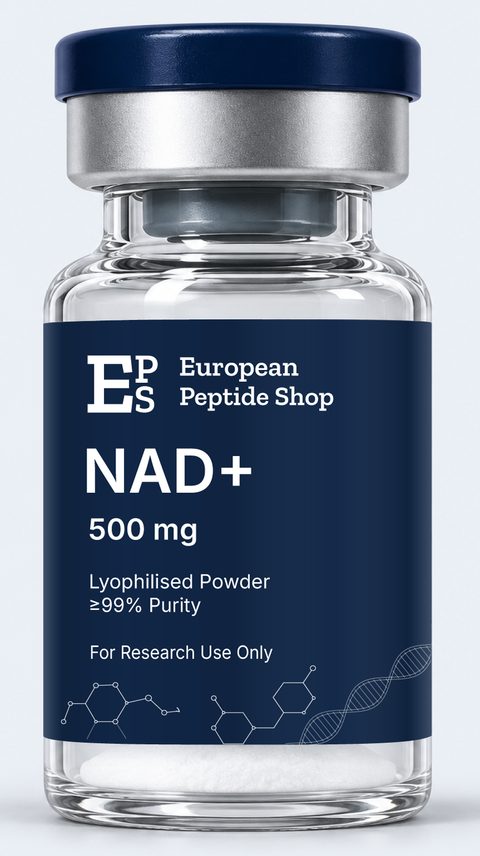
Verify that the analysis concerns NAD+ itself and that the reported result is appropriate to the question. Content, identity and impurity measurements are separate attributes. Do not apply peptide-specific mass or stability assumptions simply because NAD+ appears in a peptide supplier's catalog.
Does a 500mg label tell me the purity of NAD+?
No. The label amount, measured content and purity are different facts. Read the applicable report. If it reports content but does not report purity, do not infer a purity percentage.
Is an NAD+ research vial the same as a pharmacy product or supplement?
No. These are different formulations and supply arrangements. A research listing does not establish that the material is suitable for personal administration or interchangeable with a finished product.
EPS documentation
Use the research catalogue to check the exact name, labelled amount and format. The COA library publishes the original Janoshik reports selected for EPS, retaining the original report client name and any missing batch fields. Literature findings and another supplier's analytical results are not evidence about an EPS batch.