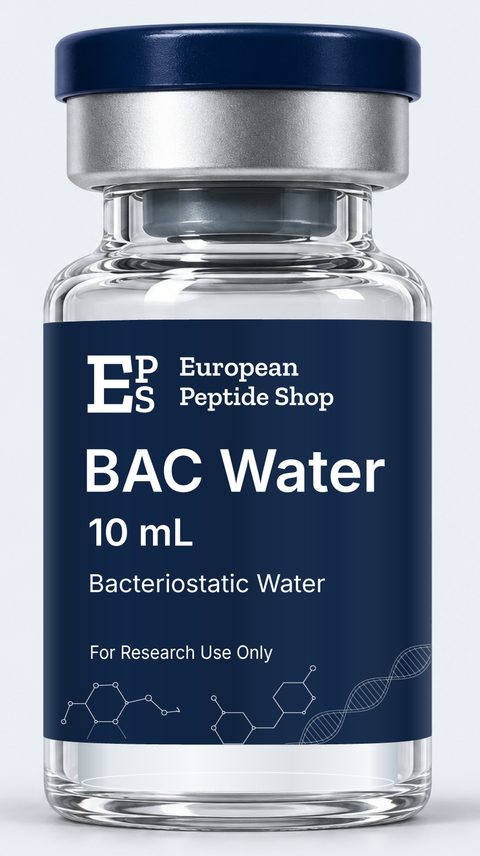
Sterile versus bacteriostatic water
Scope of this reference
This page concerns the identity and labelling of two laboratory reagents. It is not a treatment guide, a recommendation, a preparation protocol or guidance on handling any material for administration to a human or animal. No preparation procedure is given here.
The difference is a preservative
Sterile water for injection is water that has been sterilised and contains no antimicrobial preservative. Once a sealed container is opened, nothing in it inhibits microbial growth.
Bacteriostatic water is sterilised water containing an antimicrobial preservative : conventionally benzyl alcohol at 0.9% w/v. The preservative is bacteriostatic rather than bactericidal: it inhibits the multiplication of organisms rather than killing those already present.
That single compositional difference is the whole distinction, and it is what the two labels denote. Both are listed as laboratory reagents: bacteriostatic water 10ml and bacteriostatic water 3ml.
What "bacteriostatic" does and does not mean
Three points follow from the chemistry and are frequently stated incorrectly:
- A bacteriostatic agent inhibits growth; it does not sterilise a contaminated container or reverse contamination that has occurred.
- The preservative is not inert. Benzyl alcohol is a chemical constituent of the reagent, and it is a known incompatibility for certain materials and certain analytical methods.
- The presence of a preservative is a property of the reagent, not a licence for any particular use of it.
Why the distinction matters analytically
Where a reagent is used to dissolve a material for laboratory work, its composition becomes part of the experimental system. A preservative-containing diluent introduces an additional component that may interfere with an assay, a chromatographic method or a stability measurement.
Which reagent is appropriate for a given procedure is a question for a validated institutional SOP and a documented risk assessment, not for a vendor page. We do not publish preparation procedures, concentrations or volumes.
What to record
For traceability, the reagent is part of the record: the reagent name as labelled, its stated composition including preservative and concentration, the batch or lot number, the container volume, and the expiry stated by the manufacturer.
The publication status of analytical reports is shown in the COA publication status; the guides to reading a peptide COA and understanding HPLC purity explain what those documents can and cannot show.
EPS documentation
Use the research catalogue to check the exact name, labelled amount and format. The COA library publishes the original Janoshik reports selected for EPS, retaining the original report client name and any missing batch fields. Literature findings and another supplier's analytical results are not evidence about an EPS batch.