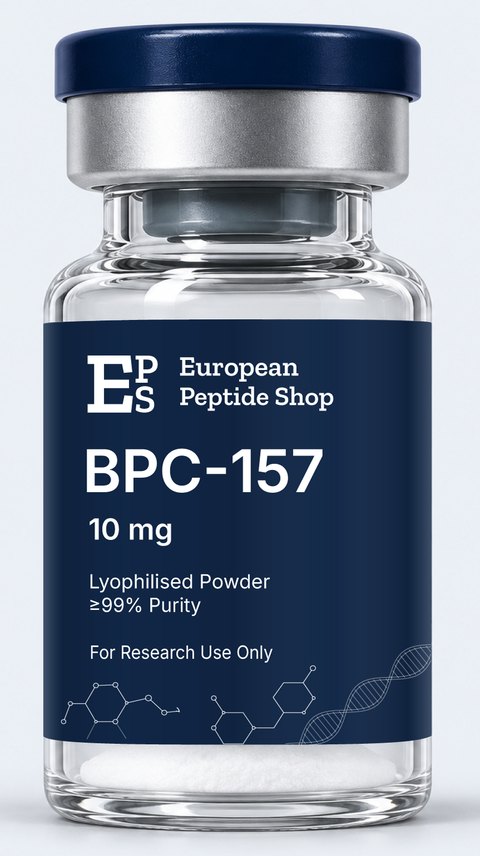
How BPC-157 works in studies
BPC-157 has been studied for its effects on several cell-signalling processes, but there is no single, fully established explanation of how it starts those changes. Researchers have reported responses involving blood-vessel cells and nitric oxide, a small signalling molecule. Observing a response is one step towards understanding a mechanism.
What is BPC-157 made of?
It is a chain of fifteen amino acids. The order of those building blocks identifies the peptide, but a sequence alone does not tell us which protein it first interacts with inside a biological system. The BPC-157 reference covers that identity question in more detail.
Compare this with Kisspeptin-10, for which researchers have examined a peptide-bound receptor structure. Different compounds can have very different levels of evidence for their first signalling step.
Which signals have BPC-157 studies examined?
A study published online in 2016 and in a 2017 journal issue examined a receptor called VEGFR2 in blood-vessel cells. A receptor is a protein that receives a chemical signal. The researchers reported changes in the amount of this receptor and its movement into cells, alongside changes in connected signalling proteins.
One of those connected proteins helps cells make nitric oxide. Nitric oxide can carry messages involved in how blood vessels behave. The experiments included cultured cells and animal models; their results belong to those settings.
The study does not settle whether the peptide directly binds that receptor. A change further along a signalling chain can happen without identifying the first point of contact.
What did the 2026 human-tissue study add?
A May 2026 study examined small artery samples left over from surgery involving twelve donors. The tissue was studied outside the body. Researchers reported relaxation of the artery samples and investigated the contribution of the vessel's inner lining and nitric-oxide signalling.
Using human tissue makes the model different from a mouse experiment. It still does not make it a clinical trial: the researchers were studying tissue in a laboratory, not testing whether people benefited from receiving the peptide.
How can readers judge a mechanism claim?
Three questions help separate what a paper measured from what a headline suggests:
| Question | Why it matters |
|---|---|
| What material was studied? | Cells, isolated tissue and whole organisms answer different questions |
| What changed? | A signal measurement is different from a clinical outcome |
| Was the first interaction identified? | Downstream changes do not necessarily reveal a binding target |
The peptide COA guide covers a separate question: what an analytical report can establish about a particular sample. Chemical identity and purity do not demonstrate a biological mechanism.
BPC-157 research provides observations that can guide further experiments. The open question is how those observations connect, and whether the proposed explanation holds when tested in other systems. That uncertainty belongs beside the mechanism, rather than being hidden at the end of a claim.
EPS documentation
Use the research catalogue to check the exact name, labelled amount and format. The COA library publishes the original Janoshik reports selected for EPS, retaining the original report client name and any missing batch fields. Literature findings and another supplier's analytical results are not evidence about an EPS batch.