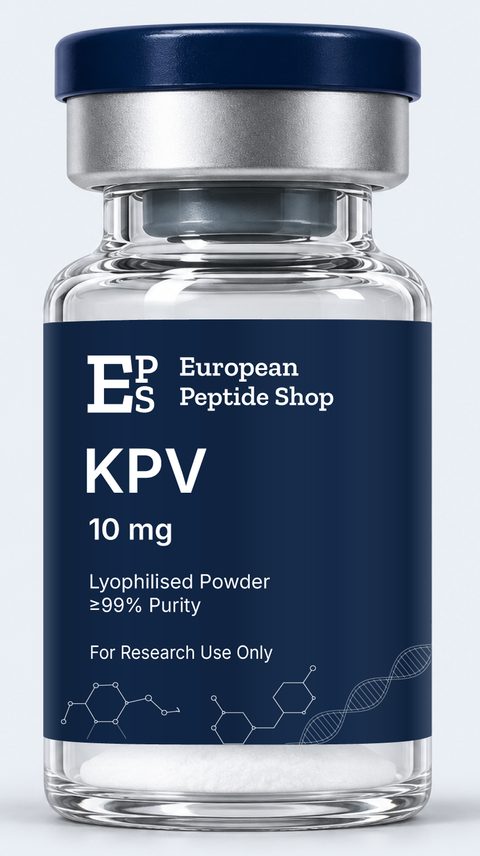
How KPV interacts with cells
KPV is a peptide made from three amino acids: lysine, proline and valine. Its small size raises a useful question: how does it get into a cell, and what can researchers measure once it is there? A widely cited study examined both steps rather than assuming that cell entry and cell response were the same thing.
How does KPV get into cells?
Cells have membranes that separate their contents from the surrounding environment. Some substances cross with help from transport proteins. One such protein, PepT1, carries short peptides across a membrane.
Think of a transporter as a moving passage through the cell's boundary. It is different from a receiver that stays in place and passes on a message. Structural research on human peptide transporters shows how these proteins can change shape during transport. That broader study is useful background; it is not itself a picture of this particular peptide being carried.
In the 2008 KPV study, scientists examined uptake in intestinal and immune-cell models. They used labelled material to track entry and competition experiments to investigate the transport process. Their findings supported a role for PepT1.
What did KPV change in the experiments?
The scientists also measured signalling related to inflammation in stimulated cells. One readout concerned NF-kB, a protein system involved in switching on certain genes. The study reported reduced activation of this system under its experimental conditions.
Keeping those measurements separate matters. Showing that material enters a cell does not, on its own, explain every later response. Showing a lower signal in one experiment does not establish the same response in another kind of cell.
Why is this more than a size comparison?
This short sequence comes from one end of a larger hormone called alpha-MSH. That family relationship does not mean the fragment has all the functions of its parent. A few building blocks taken from a longer molecule can interact with a different part of the cell.
The KPV identity guide explains that relationship. This article focuses on the evidence for cell entry and the measurements that followed it.
What can the study tell us about people?
The 2008 paper included cell experiments and mouse models. Those are useful ways to investigate a possible mechanism, but they do not establish a human outcome. The model and the material studied must stay attached to any description of the result.
| Observation | What it does not establish by itself |
|---|---|
| Peptide uptake in cultured cells | The same uptake in every tissue |
| A change in a signalling measurement | A meaningful outcome in a person |
| A result for one ingredient | The behaviour of a mixture containing it |
For that last distinction, the KLOW blend reference explains why evidence for an individual ingredient does not automatically describe a blend.
KPV offers a clear example of why mechanisms need several kinds of evidence. Researchers have to ask how the material reaches the cell, which signals change and how far those findings can reasonably be applied.
EPS documentation
Use the research catalogue to check the exact name, labelled amount and format. The COA library publishes the original Janoshik reports selected for EPS, retaining the original report client name and any missing batch fields. Literature findings and another supplier's analytical results are not evidence about an EPS batch.