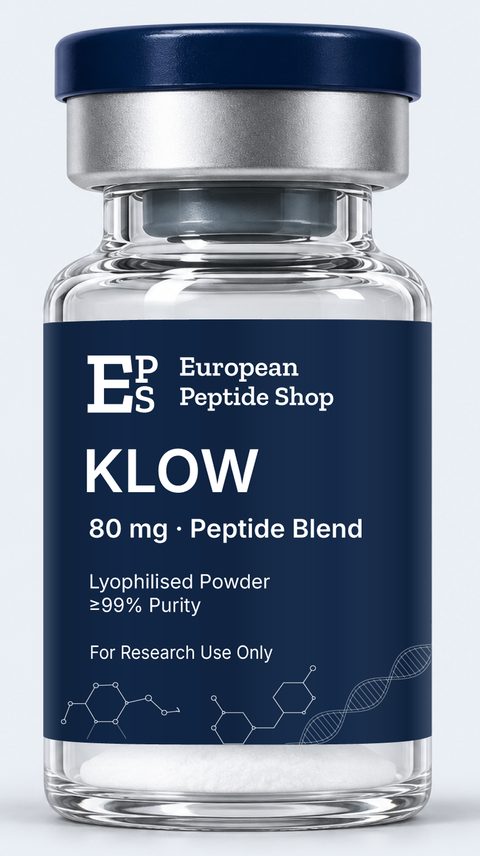
What is in the KLOW blend?
Nomenclature and synonyms
The catalogue lists it as KLOW Research Blend (80mg). "KLOW", "KLOW blend" and "KLOW 80mg" refer to this one formulation. Searches for a "KLOW pen" or "KGLOW pen" find different products: this item is a lyophilised powder in a vial, not a pre-filled pen.
Structure and classification
A multi-component mixture, not a single molecule. A blend has no single HPLC purity figure. Its certificate instead quantifies how much of each active is present.
Development and regulatory status
KLOW is a catalogue research blend. It is not a licensed medicine in the United Kingdom, none of its components is supplied here as one, and nothing on this page implies availability for human use.
What the evidence establishes
The references cited here do not establish results for this four-component commercial blend. Whatever evidence exists concerns each component on its own.
In vitro and animal findings
The component literature is predominantly cell-culture and rodent work, and it differs by compound. The component articles set out the model behind each finding: GHK-Cu, BPC-157 and TB-500.
A finding for one component does not carry over to the same component inside a mixture. Interactions between components, relative stability and the effect of the proportions are not characterised by those studies.
Human data
There is no human data for the blend. Human data for individual components is limited and varies by compound, and none of it transfers to a separately formulated mixture.
What KLOW is often confused with
- Two-component blends. BPC-157 plus TB-500 mixtures are a different formulation. BPC-157 and TB-500 explains how those two compounds differ.
- Cosmetic copper-peptide products. Serums containing GHK-Cu are formulated and sold as cosmetics. A lyophilised research vial is a different product for a different purpose.
- Single-compound vials. The same components are listed individually elsewhere in the catalogue as separate products, each with its own certificate.
Analytical documentation
A certificate for a blend should state each active separately. Confirm that every component's figure is present rather than a single combined number, and that the batch number on the vial matches the batch on the report.
A certificate describes the stated tests and results for the submitted sample. It does not establish biological effect, stability within the mixture, or that another batch is equivalent. Report publication status is shown in the COA publication status, and the KLOW product page and blends category list the current batch. The guides to reading a peptide COA and understanding HPLC purity cover what those documents can and cannot show.
EPS documentation
Use the research catalogue to check the exact name, labelled amount and format. The COA library publishes the original Janoshik reports selected for EPS, retaining the original report client name and any missing batch fields. Literature findings and another supplier's analytical results are not evidence about an EPS batch.