KPV research and evidence
KPV is a three-amino-acid peptide: lysine, proline and valine. Interest in it often centres on inflammation and gut-related findings. The underlying studies are more specific: they examine cell entry, inflammatory signals, mouse models and particular engineered formulations.
Those distinctions matter when KPV appears in a blend such as KLOW. Evidence for KPV alone does not establish the performance of the whole blend, and a result in cells or mice does not prove a human treatment benefit.
What did the KPV cell studies measure?
Dalmasso and colleagues examined KPV uptake through PepT1 in intestinal epithelial and immune-cell systems, reporting suppression of selected inflammatory responses. KPV is lysine: proline: valine. [[1]](https://pmc.ncbi.nlm.nih.gov/articles/PMC2431115/)
When reading a cellular experiment, record transport and biological response separately. A measurement showing material entering a cell answers a different question from a measurement showing what subsequently changed. Neither can replace an assessment of the experimental controls.
What did the mouse studies add?
Their study also examined two chemically induced mouse-colitis models, using inflammation-related tissue and gene-expression outcomes. [[1]](https://pmc.ncbi.nlm.nih.gov/articles/PMC2431115/)
For any animal-model paper, preserve the model name in the conclusion. Write down what was measured, the comparison group and the uncertainty. Replacing those details with a general phrase such as intestinal repair removes information that another reader needs to judge whether the finding answers their question.
Is plain KPV the same as the nanoparticle formulation in a paper?
Xiao and colleagues examined KPV within a hyaluronic-acid-functionalized nanoparticle and hydrogel system. Their work covered particle properties and cellular uptake, with improvements in selected inflammation-related outcomes in a mouse-colitis model. [[2]](https://pmc.ncbi.nlm.nih.gov/articles/PMC5498804/)
A formulation comparison should identify every part of the tested intervention. The carrier, release behavior and target-cell interaction are elements to record, rather than details to omit when summarizing the result. Material described by the same peptide name may not reproduce the experimental formulation.
Separate the material, measurement and interpretation when taking notes. This compact evidence map helps prevent a paper from being cited for a question it did not answer.
| Study setting | What was examined | What it does not establish |
|---|---|---|
| Cell systems [[1]](https://pmc.ncbi.nlm.nih.gov/articles/PMC2431115/) | Transport and inflammatory signaling | The same response in every tissue |
| Mouse colitis models [[1]](https://pmc.ncbi.nlm.nih.gov/articles/PMC2431115/) | Inflammation-related endpoints | Human clinical benefit |
| Engineered formulation [[2]](https://pmc.ncbi.nlm.nih.gov/articles/PMC5498804/) | Carrier behavior and formulation outcomes | Equivalent behavior of plain KPV |
What should I check when reading a KPV claim?
Start with a one-sentence record of the tested material and the primary endpoint. Then check whether the comparison isolates the peptide, the carrier or the complete formulation. Preserve negative results and model limitations alongside positive findings; they determine which interpretation remains defensible.
At the material level, identity, measured quantity and chromatographic purity answer different questions. The certificate verification guide explains how to keep those records separate. The GLOW and KLOW comparison explains why research on one ingredient cannot validate a finished blend.
This article addresses the interpretation of research evidence. It provides no preparation protocol, treatment recommendation or prediction of how a person would respond.
Does a KPV study validate a blend containing KPV?
No. A component study does not determine how a mixture behaves. Evidence for the actual formulation and experimental question is needed.
Can one result summarize all KPV research?
No. Report the material, model and endpoint together. Similar terminology can hide substantial differences in what was tested.
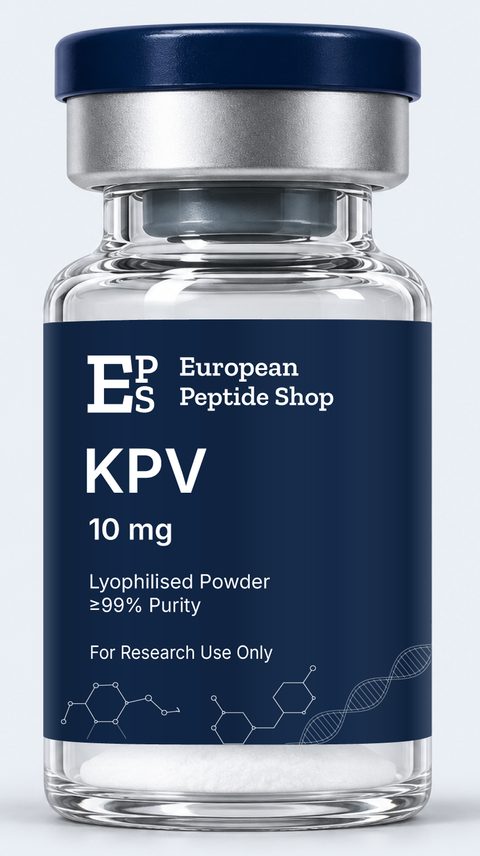
Research material information: KPV (10mg). These products are coming soon; use the notification bell on the product page for an availability email.
Does KLOW contain only KPV?
No. KLOW includes other peptides. The GLOW and KLOW comparison explains the component list and why the total blend amount is not the quantity of each ingredient.
What does KPV 10mg tell me?
It states the compound and labelled amount in that catalogue format. It does not establish a clinical benefit, a preparation method or an available batch report. Check the product’s current status and documentation separately.
Primary references
- Dalmasso et al.: PepT1 and KPV in inflammation models
- Xiao et al.: KPV nanoparticles and experimental colitis
EPS documentation
Use the research catalogue to check the exact name, labelled amount and format. The COA library publishes the original Janoshik reports selected for EPS, retaining the original report client name and any missing batch fields. Literature findings and another supplier's analytical results are not evidence about an EPS batch.