TB-500 versus thymosin beta-4
The name TB-500 alone does not reliably tell you whether a product contains full-length thymosin beta-4 or a shorter fragment. Sellers and papers can use the terminology differently. Check the stated sequence or specification and the batch-linked evidence before treating two names as interchangeable.
The useful questions are concrete: what material is declared, what sample did the lab test and what did the tests establish? A high purity percentage cannot resolve an unclear identity or prove the amount in a differently sized vial.
What is the difference between full-length thymosin beta-4 and a fragment?
| Description | Identity distinction | Evidence to request |
|---|---|---|
| Full-length thymosin beta-4 | 43-residue sequence with its specified terminal chemistry | Sequence/specification and suitable identity characterization |
| Ac-LKKTETQ | Acetylated seven-residue fragment associated with residues 17–23 | Evidence specific to that fragment and modification |
| A vial labeled TB-500 | The commercial name alone does not distinguish them | The actual material specification and batch-linked results |
Esposito and colleagues used chromatographic and mass-spectrometric methods to identify Ac-LKKTETQ in the product they analyzed. This establishes what that tested product contained. It does not prove that every supplier using TB-500 sells the same fragment. Esposito et al., 2012.
A later analysis found that the tested TB500/TB1000 products did not consistently match earlier descriptions of their contents. This provides direct evidence for checking identity instead of relying on the commercial name. It concerns the products analyzed, not the prevalence of any particular material across the whole market. Delcourt et al., 2023.
Did the study examine the same material as the listing?
A frequently cited thymosin beta-4 paper examined wound-related endpoints in a rat model and cell migration in an assay. That study is useful in its experimental context; it did not test every commercial material now sold as TB-500. Malinda et al., 1999.
When evaluating a claim, compare the study’s sequence or reagent description, modifications, model and endpoint with the material proposed for your experiment. An actin-related region within a larger peptide is not evidence that a fragment reproduces every effect reported for the full-length molecule.
Can a purity result prove which peptide it is?
A high chromatographic area percentage does not resolve an ambiguous name. A sample can be dominated by one detectable component without that percentage telling you which peptide it is. Suitable identity testing and a clear specification are needed alongside any purity result. The HPLC guide explains what the chromatogram measures.
Measured content is a third question: how much of the specified material was quantified in the tested sample? It should not be inferred by multiplying a nominal fill by a purity percentage. Preserve the method and the report’s stated sample quantity.
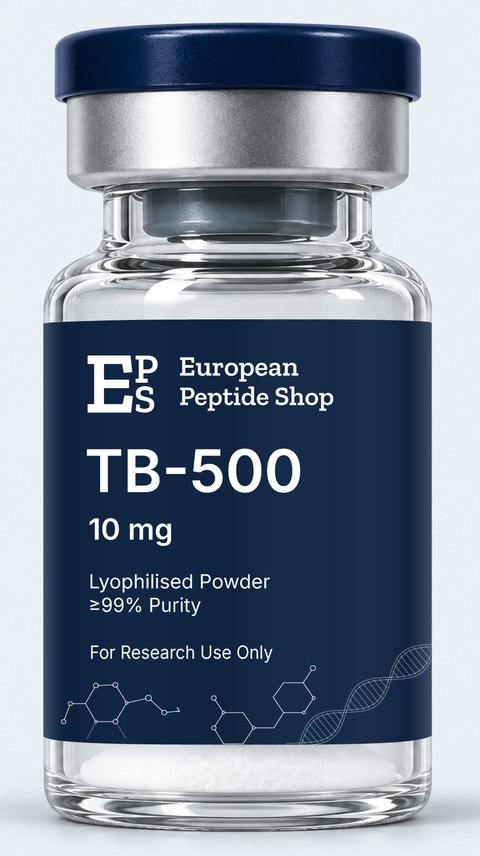
The TB-500 10 mg product page publishes the catalogue specification and the available report information. Treat that specification as the declared identity, not as a substitute for a batch identity result. Compare the report’s sample amount with the label amount; a report on a smaller sample does not establish the fill of a larger labeled vial.
If a sequence or fill result needed by the experiment is missing or unclear, ask for clarification through support. Do not resolve the uncertainty by borrowing a different supplier’s certificate or assuming a search-result synonym is chemically definitive.
What are the five checks before comparing TB-500 listings?
- Write down the required sequence and terminal modifications.
- Match that requirement to the supplier’s declared material.
- Check the exact batch and sample described in the report.
- Distinguish identity, purity and quantitative content.
- Use studies of the matching material when designing controls or interpreting an endpoint.
Does combining it with BPC-157 resolve the ambiguity?
No. A blend still requires identification of each component. The blend comparison discusses why total mass and component research are not enough to characterize a finished mixture.
Does a standalone TB-500 vial contain BPC-157?
Do not assume so. Standalone TB-500 and a BPC-157/TB-500 blend are separate listings with different ingredient descriptions. Use the actual component list, not an informal nickname or a result from another product.
Can a report on a 5mg sample verify a 10mg fill?
Not by itself. It describes the submitted sample and reported measurements. The supplier needs to explain how that sample relates to the 10mg listing; purity information is not a measurement of the larger vial’s fill.
EPS documentation
Use the research catalogue to check the exact name, labelled amount and format. The COA library publishes the original Janoshik reports selected for EPS, retaining the original report client name and any missing batch fields. Literature findings and another supplier's analytical results are not evidence about an EPS batch.