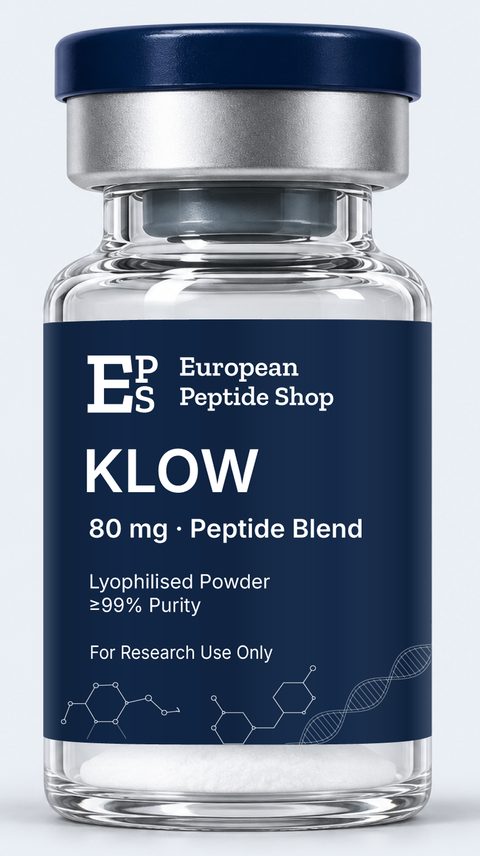
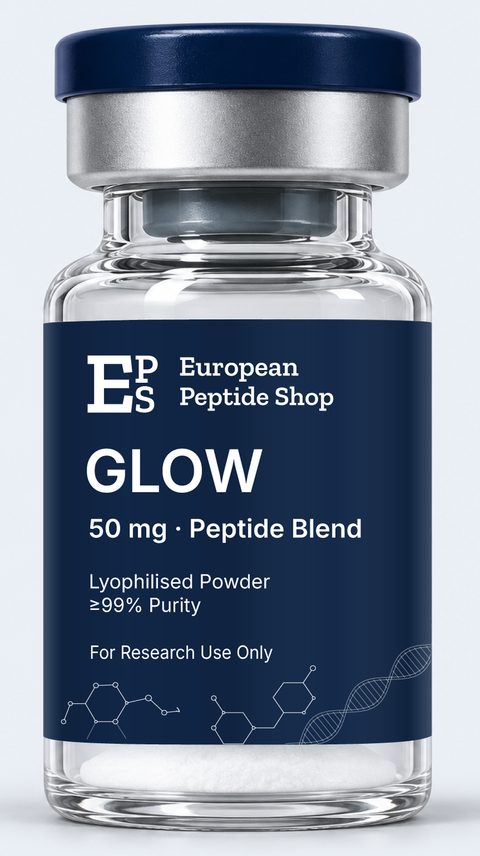
GLOW versus KLOW blends
KLOW 80mg combines GHK-Cu, BPC-157, TB-500 and KPV; 80mg is the total vial label, not the amount of each ingredient. GLOW lists the first three ingredients without KPV. The shared blend names do not guarantee identical proportions across sellers.
Compare the exact KLOW 80mg, GLOW 50mg or GLOW 70mg listing, its current status and its own documentation. A result from a study of one ingredient does not establish how the finished blend performs or whether it is suitable for personal use.
How do I compare KLOW peptide prices and ingredient amounts?
Start with the KLOW 80mg listing for its labelled format and documentation status. Compare the four named ingredients and their amounts before comparing another listing that also uses the word KLOW. A blend name and total alone do not establish identical ratios.
GLOW and KLOW are different comparisons, not interchangeable price tiers. Check the GLOW 50mg listing separately and do not use KLOW’s report as evidence for GLOW. Add shipping and any applicable quantity or coupon conditions when comparing final order costs.
What do studies of the individual ingredients show?
GHK-Cu has been investigated in fibroblast culture, including a study measuring collagen synthesis. BPC-157 has been studied in rat tendon explants and cultured tendon fibroblasts. These are different experimental systems with different endpoints; neither study tested a GLOW formulation. Maquart et al., 1988; Chang et al., 2011.
KPV research includes intestinal epithelial and immune-cell experiments and mouse colitis models examining transport through PepT1 and inflammatory signaling. That evidence explains interest in KPV as an individual research subject. It does not establish that adding KPV makes a commercial blend better, safer or more effective. Dalmasso et al., 2008.
TB-500 also needs an identity check: the name is used inconsistently in research commerce, while papers may examine full-length thymosin beta-4 or a shorter fragment. The TB-500 and thymosin beta-4 guide explains why that distinction matters.
Does adding ingredients prove a blend works better?
A mixture changes more than the number of names on a label. Each component contributes to the final sample and may complicate interpretation of an assay. A result with a mixture cannot automatically be assigned to one ingredient. Component controls and a suitable vehicle control help a laboratory distinguish an individual effect from a combined response or an assay artifact.
The studies cited here support questions to investigate, not a claim that the commercial combinations have been validated. Terms such as synergy, broader recovery or anti-aging require evidence for the actual mixture and endpoint; they cannot be inferred from the component list.
How do I check each ingredient on the lab report?
- Match the product and batch rather than accepting a generic blend report.
- Distinguish the total label quantity from each measured component amount.
- Check whether the method separates the components and whether results describe identity, purity or quantitative content.
- Keep original units and any stated uncertainty or limitations.
- Ask about missing results; an unreported test is not a passing result.
A single purity percentage cannot describe every relevant property of a multi-component material. The certificate verification guide provides a fuller checklist.
EPS documentation
Use the research catalogue to check the exact name, labelled amount and format. The COA library publishes the original Janoshik reports selected for EPS, retaining the original report client name and any missing batch fields. Literature findings and another supplier's analytical results are not evidence about an EPS batch.