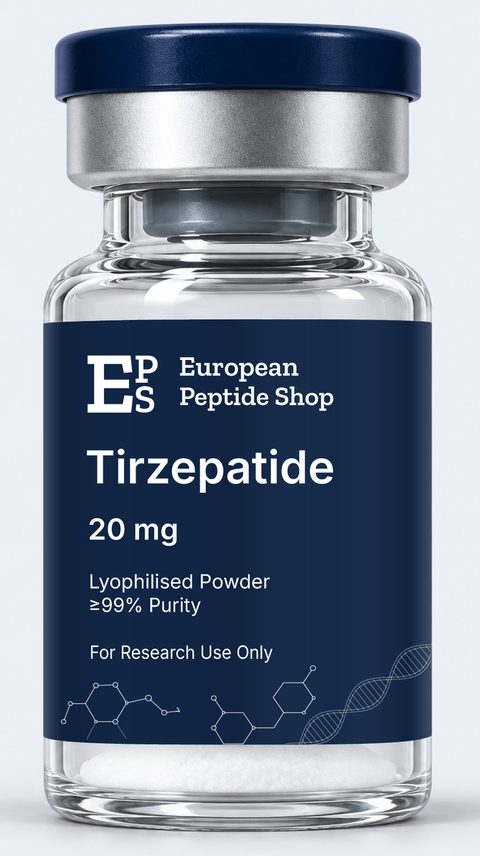
Tirzepatide research explained
What tirzepatide is
Tirzepatide (development code LY3298176) is a synthetic peptide of 39 amino acids built on the sequence of glucose-dependent insulinotropic polypeptide (GIP). It carries a C20 fatty diacid chain attached through a linker to a lysine residue, which binds the peptide to albumin in circulation and slows its clearance. It was designed to act at two receptors at once: the GIP receptor (GIPR) and the glucagon-like peptide-1 receptor (GLP-1R). The developer is Eli Lilly.
Is tirzepatide a peptide? Yes. It is a single-chain peptide with a lipid modification, in the same structural family as semaglutide, which is a GLP-1 analogue with a C18 fatty diacid. Tirzepatide is sometimes described as a GLP-1 compound, which is incomplete: its backbone is GIP-derived and its GLP-1 receptor activity is the engineered part.
The licensed medicine and the research reagent
Tirzepatide is the active ingredient of Mounjaro, a medicine licensed in the UK by the MHRA, and of Zepbound in the United States. A licensed medicine is a finished product with a marketing authorisation, a stated indication, a manufacturer and a pharmacovigilance record.
Research-grade tirzepatide is a laboratory reagent. It shares a molecular identity with the medicine and nothing else: no authorisation, no indication and no clinical use. A batch certificate, where one exists, reports what was measured in that batch, which is identity and purity, and says nothing about biological activity.
Receptor pharmacology
Tirzepatide is often called a dual agonist. The published in vitro characterisation reports that its activity at the two receptors is not balanced.
| Receptor | Natural ligand | Reported tirzepatide activity |
|---|---|---|
| GIPR | GIP | Comparable to native GIP |
| GLP-1R | GLP-1 | Lower than native GLP-1, by a wide margin |
The 2018 paper by Coskun and colleagues in Molecular Metabolism, written by the developer, is the main source for this profile. Because the authors are the developer, this is developer-reported data. Later independent work has also described biased signalling at GLP-1R, meaning the peptide favours some downstream pathways over others. Which of these in vitro properties explains the clinical results is still argued in the literature.
What the trial programmes report
Two programmes of phase 3 trials have been published. SURPASS enrolled adults with type 2 diabetes and measured change in HbA1c and body weight. SURMOUNT enrolled adults with obesity or overweight, mostly without diabetes, and measured change in body weight. The SURMOUNT-1 paper by Jastreboff and colleagues appeared in the New England Journal of Medicine in 2022. A direct comparison against semaglutide in people without diabetes, SURMOUNT-5, was published in 2025.
These are trials of the licensed medicine in human participants. They describe the medicine. They do not describe what a research batch does, and they do not transfer to a vial of lyophilised powder.
| Statement | Evidence tier |
|---|---|
| The peptide activates GIPR and GLP-1R | In vitro, developer-reported |
| The medicine lowered HbA1c in type 2 diabetes | Human, phase 3, published |
| The medicine reduced body weight in trial participants | Human, phase 3, published |
| What any research batch does biologically | Not established by anything on this page |
Open questions
- GIP's contribution. The role of the GIP receptor in the clinical effect is still not settled. Single GIP agonists and GIP antagonists have both been studied, which shows how unresolved it is.
- Independent pharmacology. Most of the receptor characterisation comes from the developer.
- Generic terms. The phrases "compounded tirzepatide" and "tirzepatide compound" describe pharmacy-made products in other countries. They have no bearing on a research material.
Tirzepatide is set against the two adjacent molecules in the retatrutide, tirzepatide and semaglutide comparison, and the receptor difference from semaglutide alone is covered in tirzepatide vs semaglutide.
EPS documentation
Use the research catalogue to check the exact name, labelled amount and format. The COA library publishes the original Janoshik reports selected for EPS, retaining the original report client name and any missing batch fields. Literature findings and another supplier's analytical results are not evidence about an EPS batch.