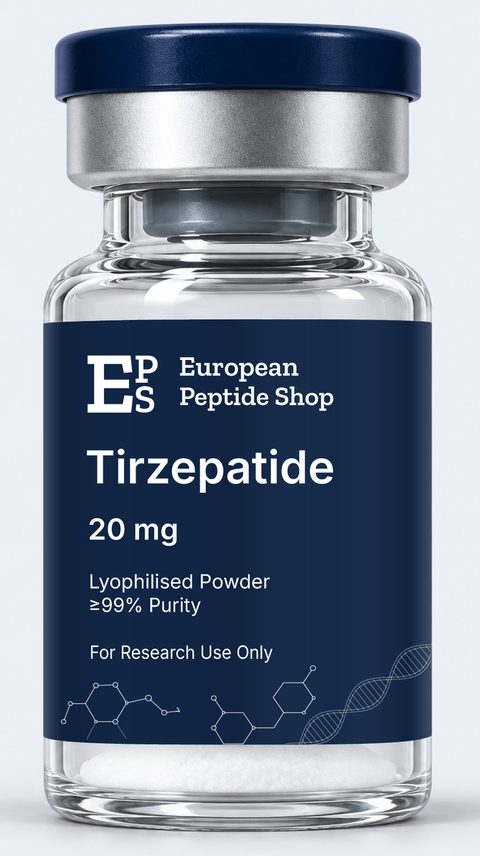
Tirzepatide versus semaglutide
Two different molecules
Tirzepatide and semaglutide are often treated as versions of the same thing. They are related in purpose and in format, and different in sequence.
| Property | Semaglutide | Tirzepatide |
|---|---|---|
| Developer | Novo Nordisk | Eli Lilly |
| Backbone sequence | Human GLP-1 analogue, 31 residues | GIP-derived, 39 residues |
| Receptors engaged | GLP-1R | GIPR and GLP-1R |
| Lipid modification | C18 fatty diacid | C20 fatty diacid |
| Licensed products | Ozempic, Wegovy, Rybelsus | Mounjaro, Zepbound |
Semaglutide is a modified copy of the body's own GLP-1 with two amino acid substitutions, one of which protects it from the enzyme DPP-4. Tirzepatide starts from GIP and is engineered so that it also activates the GLP-1 receptor. That is why "tirzepatide vs Ozempic" and "tirzepatide vs Mounjaro" are not like-for-like phrases: Ozempic is a semaglutide product, and Mounjaro is tirzepatide itself under a brand name.
Receptor coverage
The single most cited difference is the second receptor. Semaglutide acts at GLP-1R alone. Tirzepatide acts at GIPR with activity close to native GIP, and at GLP-1R with lower potency than native GLP-1. The developer's own in vitro data is the main source for that profile, as set out on the tirzepatide identity page.
Whether the GIP receptor adds anything in people is the open scientific question. It cannot be answered by studying tirzepatide alone, because its two activities arrive in one molecule and cannot be separated in the same participant.
What the head-to-head trials compared
Two published trials put the medicines against each other directly.
SURPASS-2, published by Frías and colleagues in the New England Journal of Medicine in 2021, compared tirzepatide with semaglutide in adults with type 2 diabetes and reported change in HbA1c and body weight. SURMOUNT-5, published in 2025, compared the two in adults with obesity and without diabetes and reported change in body weight. In both, the reported reductions were larger in the tirzepatide groups.
Three limits apply to reading those papers.
- Each compared specific licensed products at specific strengths. The result belongs to those products.
- Both were funded by the maker of tirzepatide.
- Neither says anything about a research reagent. A lyophilised vial has an identity and a purity figure, measured on a batch certificate, and no clinical record.
Reading the comparison correctly
The comparison above is of sequence, receptor pharmacology and the published record of the medicines. Nothing in it describes what either material does in any system, and neither trial result transfers to a research reagent. The identity and purity of a reagent are established by its own batch certificate, which the guide to reading a peptide COA explains.
For the three-way picture including the triple agonist, see retatrutide, tirzepatide and semaglutide. The wider distinction between incretin peptides and older research peptides is in GLP-1 peptides vs classic research peptides.
EPS documentation
Use the research catalogue to check the exact name, labelled amount and format. The COA library publishes the original Janoshik reports selected for EPS, retaining the original report client name and any missing batch fields. Literature findings and another supplier's analytical results are not evidence about an EPS batch.