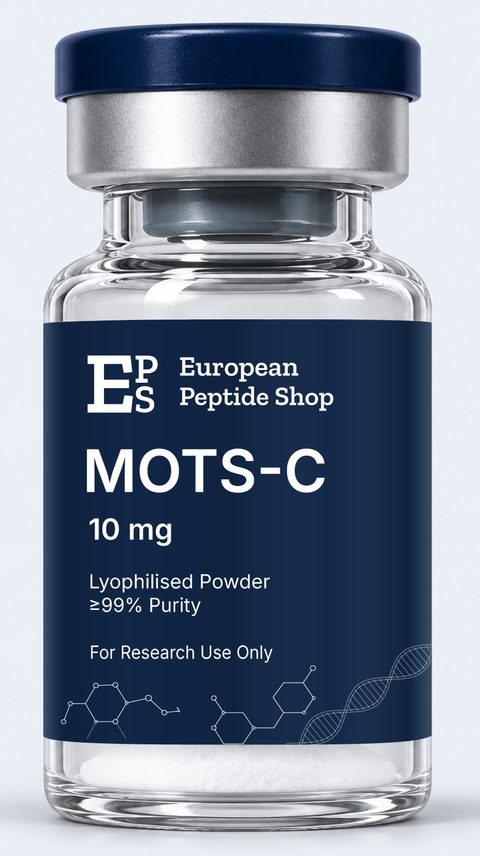
What is MOTS-c?
What MOTS-c is
MOTS-c is a 16-amino-acid peptide encoded in mitochondrial DNA rather than in the nuclear genome. The name abbreviates "mitochondrial open reading frame of the 12S rRNA-c": the short reading frame inside the mitochondrial 12S rRNA gene from which the peptide is translated. It was first reported in 2015 by Lee and colleagues at the University of Southern California.
That origin is the useful identity fact. Most peptides in this catalogue are synthetic analogues or fragments of nuclear-encoded proteins. MOTS-c belongs to a small group called mitochondrial-derived peptides, which are produced from the organelle's own genome.
Nomenclature and synonyms
"MOTS-c", "MOTS c" and "MOTSc" are spellings of one sequence: Met-Arg-Trp-Gln-Glu-Met-Gly-Tyr-Ile-Phe-Tyr-Pro-Arg-Lys-Leu-Arg, roughly 2,174.6 Da (CAS 1627580-64-6). The "-c" is part of the name, not a variant suffix.
Structure and classification
A single-chain linear peptide. It is not a blend, not a fragment cut from a larger nuclear protein, and not a licensed medicine.
Why mitochondrial encoding matters
Mitochondria carry their own small genome, separate from the nuclear one. A peptide translated from it sits outside the usual picture of nuclear genes producing proteins that are then trimmed. For a reader, this is mainly a naming and classification point: MOTS-c is a native sequence with a defined genetic origin, which is different from a designed analogue.
Supplied form
Lyophilised powder in a single-compound vial, listed on the MOTS-c 10mg product page.
Development and regulatory status
MOTS-c is an investigational research compound. It is not a licensed medicine in the United Kingdom, and nothing on this page implies availability for human use. The catalogue item is a laboratory reagent, supplied for non-clinical in-vitro research only.
What the evidence establishes
Every finding below is labelled by model. None is a demonstrated human outcome.
In vitro and animal findings
The 2015 founding report combined cell experiments with studies in mice. In those models skeletal muscle appeared to be the main target tissue, and the cellular effects were linked to the folate cycle and AMPK signalling. Later rodent work applies the peptide to further metabolic and exercise models.
Cell and rodent findings establish behaviour in that species and system. They do not predict the same behaviour in people, and reported effect sizes depend heavily on the strain, diet and protocol used.
Human data
Human data are largely observational. A 2021 review (Woodhead and Merry) summarises reports that concentrations of endogenous MOTS-c in skeletal muscle and plasma change after acute high-intensity exercise. Measuring a naturally occurring peptide is evidence about biology, not about a supplied research material.
What MOTS-c is often confused with
- Humanin. Another mitochondrial-derived peptide, encoded in a different mitochondrial gene (16S rRNA). It is a separate molecule, not an alternate name.
- Pens and combination products. Listings elsewhere that sell MOTS-c as pre-filled pens or inside blends are different products from the single-compound vial described here.
- MOTS-c analogues. Modified versions designed in development programmes are different molecules with different masses. Evidence for one does not transfer to another.
Analytical documentation
The guides to reading a peptide COA and understanding HPLC purity explain what those documents can and cannot show. For the wider group of compounds studied around mitochondrial function, see the mitochondrial category and the MOTS-c buying guide.
EPS documentation
Use the research catalogue to check the exact name, labelled amount and format. The COA library publishes the original Janoshik reports selected for EPS, retaining the original report client name and any missing batch fields. Literature findings and another supplier's analytical results are not evidence about an EPS batch.
References
- Lee C, Zeng J, Drew BG, et al. The mitochondrial-derived peptide MOTS-c promotes metabolic homeostasis and reduces obesity and insulin resistance. Cell Metabolism. 2015;21(3):443-454.
- Woodhead JST, Merry TL. Mitochondrial-derived peptides and exercise. Biochimica et Biophysica Acta, General Subjects. 2021;1865(12):130011.