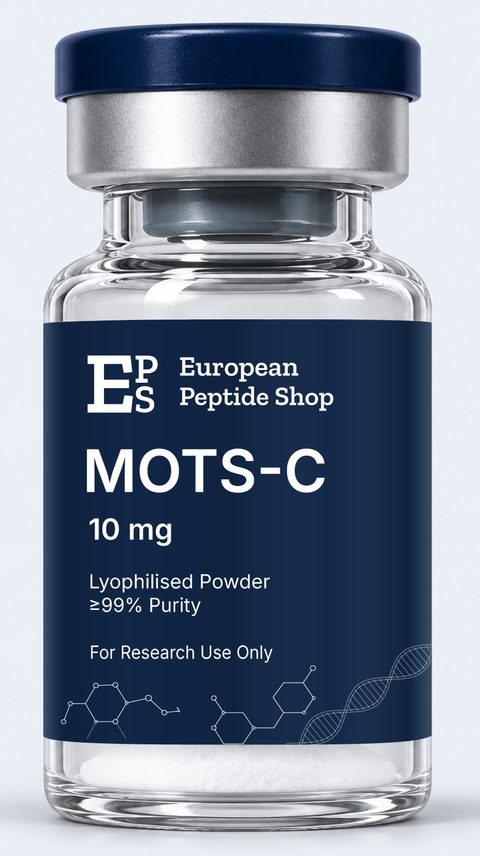
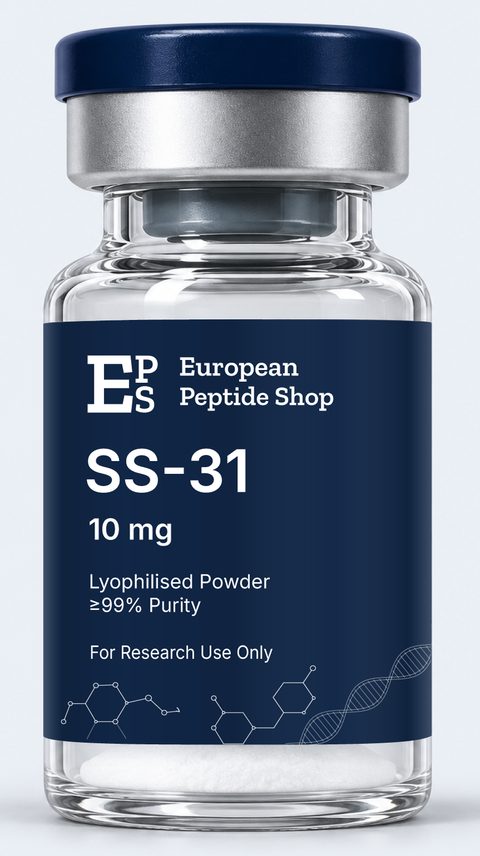
MOTS-c versus SS-31
SS-31 and MOTS-c are different peptides, not two names for the same product. SS-31 is also known as elamipretide. MOTS-c is a mitochondria-derived peptide investigated in metabolism and exercise-related work. Sharing a connection to mitochondria does not make their identities, evidence or catalogue prices interchangeable.
Mitochondria are parts of cells involved in energy metabolism. That broad connection explains why these names appear together, but it is not an outcome in itself. A useful comparison separates the material, the study and the actual product being discussed.
How do their identities and evidence differ?
| Question | SS-31 / elamipretide | MOTS-c |
|---|---|---|
| What is it? | A peptide described in FDA product information as a mitochondrial cardiolipin binder. | A 16-amino-acid peptide identified in mitochondrial-derived signalling research. |
| Which evidence is discussed here? | FDA information on the specific prescription product Forzinity. | Original cell/animal research and a study measuring naturally occurring MOTS-c after exercise in people. |
| What should not be inferred? | That a research vial is Forzinity or shares its approval. | That changes in natural MOTS-c after exercise prove benefits from administering a catalogue product. |
Sources for these distinctions: FDA’s Forzinity snapshot; Lee and colleagues’ original MOTS-c study; Reynolds and colleagues’ exercise study.
Is elamipretide FDA approved?
FDA granted accelerated approval to the prescription product Forzinity on 19 September 2025 to improve muscle strength in adults and children with Barth syndrome who weigh at least 30kg. The agency describes further trials to confirm benefit and notes that the initial randomized study did not show superiority on its primary endpoints. This specific approval does not cover general longevity claims or research vials sold as SS-31. FDA approval and trial summary.
What have MOTS-c studies actually measured?
The original MOTS-c work described a 16-amino-acid peptide and examined metabolic pathways, including AMPK-related signalling, using cell and mouse experiments. These findings support specific biological research questions; they do not establish a treatment outcome for people. Lee et al., 2015.
A later study reported physical-performance findings in mice and measured naturally occurring MOTS-c in human muscle and circulation after exercise. The human exercise observations were not a trial demonstrating the benefits of administering a MOTS-c product. Reynolds et al., 2021.
FDA’s compounding safety discussion identifies concerns about MOTS-c characterisation, impurities and potential immune reactions, with important gaps in human-exposure information. That is another reason not to turn an experimental finding into a personal-use promise. FDA’s substance-specific safety information, checked 16 September 2026.
Can price per mg tell me which compound is better?
No. Price per labelled mg compares purchase quantities, not effects. An SS-31 10mg listing and a MOTS-c 10mg listing name different compounds. The shared 10mg amount does not make them equivalent or establish that one can replace the other.
What should I check on a lab report?
Match the named material, batch and sampled vial size. Read identity, purity and measured-content results separately. A testing claim does not establish that a missing assay was performed, and a report for one peptide does not cover the other. The CoA verification guide explains those checks.
Where does NAD+ fit?
NAD+ is a coenzyme, not another name for either peptide. The NAD+ guide separates NAD+, NADH and the precursors NR and NMN. Keep each material’s studies and product information attached to the exact substance.
EPS documentation
Use the research catalogue to check the exact name, labelled amount and format. The COA library publishes the original Janoshik reports selected for EPS, retaining the original report client name and any missing batch fields. Literature findings and another supplier's analytical results are not evidence about an EPS batch.