Selank research explained
What Selank is
Selank is a synthetic heptapeptide with the sequence Thr-Lys-Pro-Arg-Pro-Gly-Pro, about 751.9 Da. It is built on tuftsin, a four-residue fragment of immunoglobulin G (Thr-Lys-Pro-Arg), extended at the C-terminus with Pro-Gly-Pro. Most of the published work comes from Russian research institutes. It is not a licensed medicine in the UK.
Names and spellings
"Selank" is the usual name. Older papers also call it TP-7 and describe it as a tuftsin analogue. It is a different molecule from tuftsin itself and from Semax.
Supplied form
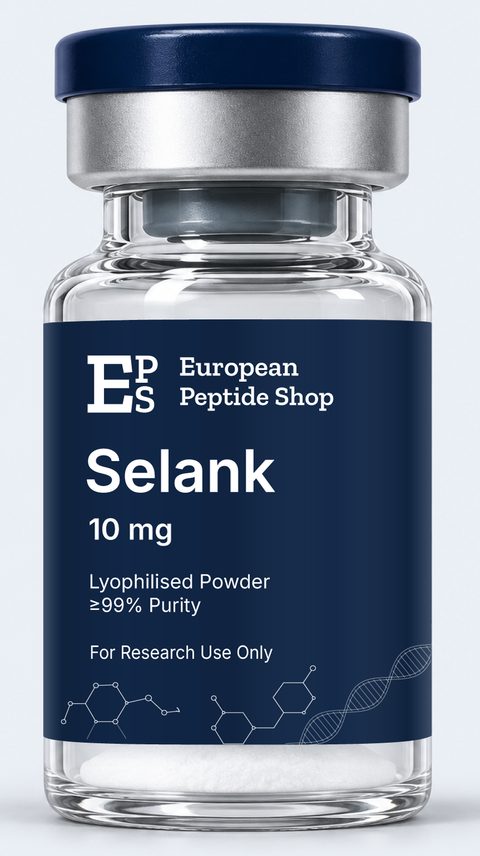
Lyophilised powder in a 10mg single-compound vial, listed on the Selank 10mg product page. The Selank buying guide covers the catalogue side.
Development and regulatory status
Selank has no UK marketing authorisation, and the cited literature does not establish an FDA or EMA authorisation. The clinical literature is small and largely in Russian. Nothing on this page implies that Selank is licensed, prescribable or available for human use in the UK.
Animal findings
Published studies are in rats and mice. Examples:
- A rat model of morphine withdrawal (2022).
- A rat model of ethanol-induced memory impairment, with brain-derived neurotrophic factor measured in brain tissue (2019).
- Rat studies of anxiety-related behaviour using TP-7, the older name (2006).
Gene-expression findings
Studies in mouse spleen and rat hippocampus report changes in the expression of immune-related and membrane-protein genes after Selank. These are mRNA measurements in animal tissue. On their own they say nothing about function in people.
Human data
One randomised comparison in 62 patients with generalised anxiety disorder and neurasthenia, comparing Selank with medazepam, was published in Russian in 2008. It is small, used an active comparator rather than placebo, and the cited record does not establish independent replication. It concerns a clinical product in diagnosed patients and cannot be transferred to a research reagent.
What Selank is often confused with
| Compound | Parent | Sequence |
|---|---|---|
| Selank | Tuftsin | Thr-Lys-Pro-Arg-Pro-Gly-Pro |
| Tuftsin | Immunoglobulin G heavy chain | Thr-Lys-Pro-Arg |
| Semax | ACTH(4-10) | Met-Glu-His-Phe-Pro-Gly-Pro |
Selank and Semax share a Pro-Gly-Pro extension at the C-terminus, which is why they are listed together. They come from different parent peptides and are not interchangeable. Semax and Selank are compared on their own page, and the Semax research overview covers the other compound. The rest of this group is in the nootropic category.
Analytical documentation
A certificate reports identity and measured purity for the batch tested. It says nothing about biological effect and does not extend to other batches. The guides to reading a peptide COA and understanding HPLC purity explain the limits.
EPS documentation
Use the research catalogue to check the exact name, labelled amount and format. The COA library publishes the original Janoshik reports selected for EPS, retaining the original report client name and any missing batch fields. Literature findings and another supplier's analytical results are not evidence about an EPS batch.
References
- Kolik LG, Nadorova AV, Antipova TA, et al. Selank, peptide analogue of tuftsin, protects against ethanol-induced memory impairment by regulating of BDNF content in the hippocampus and prefrontal cortex in rats. Bull Exp Biol Med. 2019;167(5):641-644.
- Konstantinopolsky MA, Chernyakova IV, Kolik LG. Selank, a peptide analog of tuftsin, attenuates aversive signs of morphine withdrawal in rats. Bull Exp Biol Med. 2022;173(6):730-733.
- Kolomin T, Shadrina M, Andreeva L, et al. Expression of inflammation-related genes in mouse spleen under tuftsin analog Selank. Regul Pept. 2011;170(1-3):18-23.