Semax versus Selank
Semax and Selank are different peptides, and the studies below do not establish which is better for focus or calm. They examine different systems and outcomes. Comparing their headlines without those details can make unrelated results look like a direct contest.
The simplest way to read the evidence is to separate what was tested from what was measured. A small human brain-imaging study, an animal gene-expression study and a cell experiment each answer a different question.
Are the studies asking the same question?
The existing Semax research guide covers Semax background and the broader interpretation of its literature. This comparison has a different purpose: to distinguish acute brain-network measurements from targeted gene-expression experiments.
A claim about imaging, a claim about messenger RNA and a claim about everyday cognition require different evidence. Giving all three the same label does not make their results directly comparable. None of the three studies summarized here is a head-to-head Semax-versus-Selank trial.
What did the Semax brain-imaging study find?
A small Semax study compared resting-state brain imaging in 14 participants with 10 placebo participants over 20 minutes, reporting a difference in default-mode-network topography. [[1]](https://pubmed.ncbi.nlm.nih.gov/30225715/)
This is an acute imaging observation, not evidence of durable cognitive improvement. More generally, the size or direction of an imaging signal cannot be ranked as better or worse without an outcome and an interpretation appropriate to the method.
An evidence summary should therefore keep an imaging result under its own heading. A behavioral test, a clinical assessment and a molecular assay can complement one another, but none should silently stand in for the others.
What did the Selank studies find, including the negative result?
A Selank rat experiment examined a panel of 84 neurotransmission-related genes in frontal-cortex tissue at two time points. It found time-dependent expression changes and compared patterns with GABA. [[2]](https://pmc.ncbi.nlm.nih.gov/articles/PMC4757669/)
In IMR-32 neuroblastoma cells, Selank alone did not significantly change the studied messenger-RNA measurements. Combination experiments with GABA or olanzapine produced different patterns. [[3]](https://pmc.ncbi.nlm.nih.gov/articles/PMC5328971/)
Record that null result alongside positive findings. A selected result should not disappear because it complicates a simple story. Conversely, a null measurement in one system is not a universal finding about every possible biological outcome.
These examples also show why the comparison group belongs in the summary. An experiment testing a compound alone asks a different question from one examining how a combination changes a response.
How do the study outcomes differ?
This evidence map shows why the papers cannot be placed on a single effectiveness ladder. Before using any one as support, match the proposed claim to the study's actual outcome.
| Material and study | Measurement | Interpretation boundary |
|---|---|---|
| Semax, human imaging [[1]](https://pubmed.ncbi.nlm.nih.gov/30225715/) | Acute network topography | Not a test of durable cognitive improvement |
| Selank, rat tissue [[2]](https://pmc.ncbi.nlm.nih.gov/articles/PMC4757669/) | Targeted gene-expression panel | Not a human performance trial |
| Selank, IMR-32 cells [[3]](https://pmc.ncbi.nlm.nih.gov/articles/PMC5328971/) | Messenger RNA; null result for Selank alone | Specific to the tested conditions |
Which is better for focus or calm?
These studies cannot answer that comparison. They use different materials, models and outcomes, and do not establish an overall human-performance ranking.
What should accompany a research comparison?
Record the exact material, model, control, endpoint and limitations. Match the material's identity and documentation using the COA guide, without treating a purity result as proof of biological effectiveness.
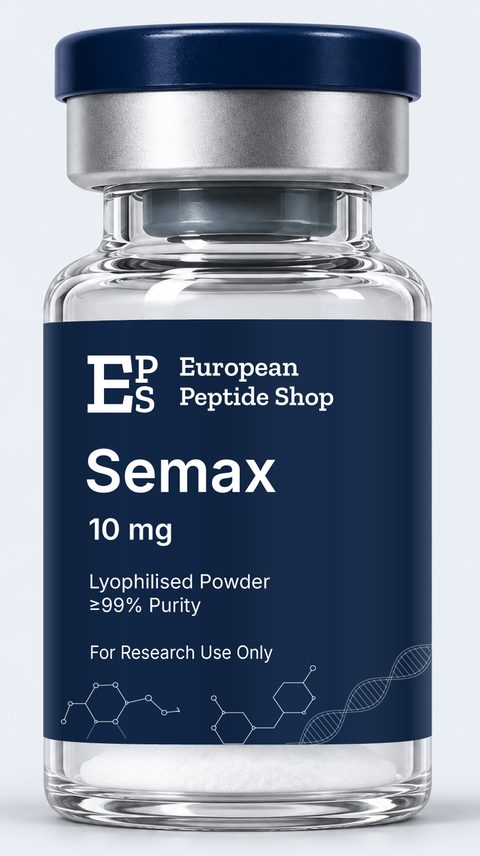
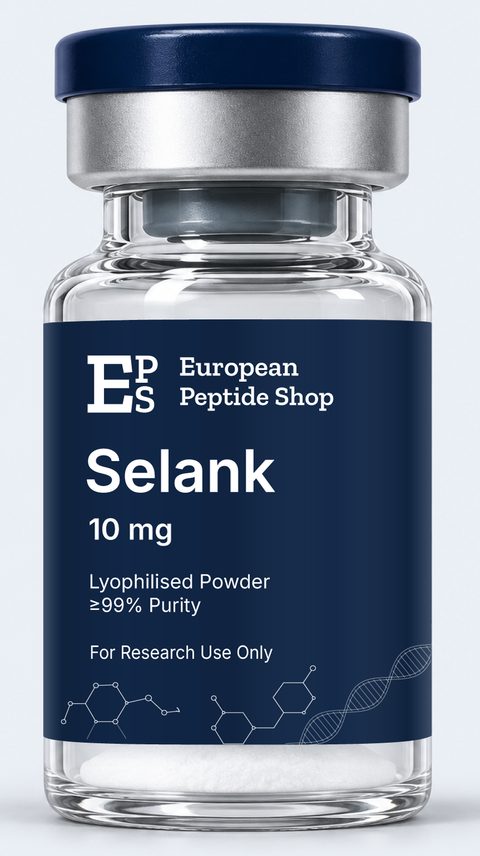
Research material information: Semax (10mg), Selank (10mg). These products are coming soon; use the notification bell on the product page for an availability email.
Can lab testing tell me which is better for focus?
No. A material report may assess identity, purity or amount. It does not measure an everyday cognitive benefit or compare the clinical effects of Semax and Selank.
What should I check on each product page?
Treat each peptide and vial size separately. Check the declared identity, current availability and any relevant batch report. One product’s report does not automatically cover the other.
Primary references
- Lebedeva et al.: Semax and acute default-mode-network imaging
- Volkova et al.: Selank and rat neurotransmission-related gene expression
- Selank, GABA and olanzapine in IMR-32 cells
EPS documentation
Use the research catalogue to check the exact name, labelled amount and format. The COA library publishes the original Janoshik reports selected for EPS, retaining the original report client name and any missing batch fields. Literature findings and another supplier's analytical results are not evidence about an EPS batch.