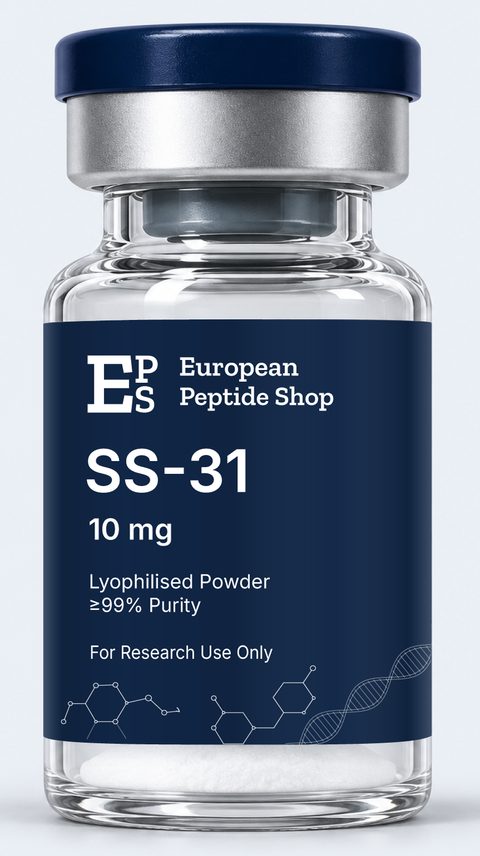
SS-31 and mitochondrial membranes
SS-31 is a short peptide studied for its interactions with the inner membrane of mitochondria. Mitochondria are structures that help cells turn fuel into a usable energy supply. The research asks how this peptide interacts with membrane components and what happens to the processes taking place around them.
What is SS-31 made of?
It has four amino-acid building blocks and is also called elamipretide. Some parts of the molecule carry an electrical charge, while others have ring-shaped chemical groups. The arrangement matters because it helps explain how the peptide interacts with a membrane rather than simply floating in the fluid around it.
You do not need to memorise the full chemical sequence to understand the main idea. The structure is relevant because different parts of a molecule interact differently with water, fats and proteins.
Where does SS-31 interact with mitochondria?
One focus is cardiolipin, a fat-like molecule found in the inner mitochondrial membrane. That membrane is folded and holds much of the machinery used to make ATP, a molecule cells use to transfer energy.
A 2013 study reported an interaction between the peptide and cardiolipin. The work also examined mitochondrial changes in a rat model. It helped connect the membrane interaction to questions about energy production under the conditions tested.
Why does a small membrane interaction matter?
Another component, cytochrome c, normally helps pass electrons along the energy-producing machinery. Its behaviour can change when it interacts with cardiolipin. Researchers have studied whether the peptide changes that relationship.
In a 2014 study, scientists used simplified membrane systems and isolated mitochondria to examine the interaction. They reported effects on cytochrome c's behaviour and on measurements related to energy production. The methods included measurements of molecular interactions and oxygen use.
A simplified membrane is useful because researchers can control what goes into it. It also leaves out much of the complexity of a living organism. Both points matter when interpreting the result.
Is this the same idea as MOTS-c?
No. The MOTS-c explainer describes research on energy-related signals and changes in gene activity. This article concerns interactions involving a mitochondrial membrane. Two peptides can be discussed under the same broad topic while being studied for different reasons.
The NAD+ reference introduces another distinct molecule involved in cell chemistry. A shared connection to energy does not make these materials substitutes for one another.
How should a reader interpret the findings?
Ask what the researchers actually used: a model membrane, isolated mitochondria, cells or an animal. Then check what they measured. Binding, oxygen use and ATP production are different observations, even when they help investigate the same question.
SS-31 studies show how a very short peptide can be investigated through its interactions with a cell structure. These particular experiments explain parts of a mechanism; they do not establish every claimed effect or describe every product carrying the same name.
EPS documentation
Use the research catalogue to check the exact name, labelled amount and format. The COA library publishes the original Janoshik reports selected for EPS, retaining the original report client name and any missing batch fields. Literature findings and another supplier's analytical results are not evidence about an EPS batch.