How tesamorelin's mechanism works
The proposed mechanism in outline
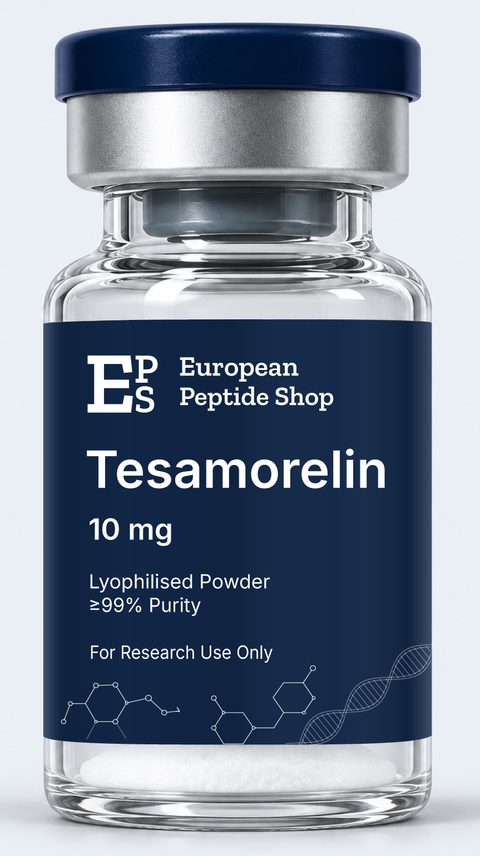
Tesamorelin is a modified copy of human growth hormone-releasing hormone (GHRH). The proposed mechanism is the one GHRH itself uses. The peptide binds the GHRH receptor on pituitary somatotroph cells, the receptor signals through cyclic AMP, and the cell makes and releases growth hormone (GH), which in turn raises insulin-like growth factor-1 (IGF-I). A chemical group added at the front end of the peptide slows its breakdown.
How well each step is established varies. The receptor biology rests on work with native GHRH in animal and cell systems. The GH and IGF-I response to tesamorelin has been measured in people. Everything further downstream is association, not a demonstrated pathway.
This page is only about how the compound is proposed to work. What it is and how it is classified is on the tesamorelin identity page. It is not a treatment guide, a recommendation or a human-use protocol.
Primary target: the GHRH receptor
Reviews of native GHRH describe a seven-transmembrane receptor coupled to a Gs protein on pituitary somatotrophs. Binding leads to release of GH from secretory granules and to a rise in intracellular cyclic AMP, then to activation of the transcription factor CREB and of Pit-1, which the GH gene needs (Mayo and colleagues, 1995). The receptor belongs to family B-III of the G protein-coupled receptor superfamily and is expressed mainly in the pituitary. It signals predominantly through cyclic AMP, with activation of the MAP kinase pathway also reported (Mayo and colleagues, 2000). Somatostatin is thought to oppose the same pathway by suppressing cyclic AMP.
These are studies of native GHRH. None of the papers cited here measures tesamorelin binding to the receptor directly. That it acts at this receptor is inferred from its structure as a 44-residue GHRH analogue and from the GH release it produces.
Model systems the targets were identified in
| Finding | System | Source |
|---|---|---|
| The GHRH receptor is Gs-coupled and raises cyclic AMP | Pituitary somatotroph work and receptor cloning | Mayo and colleagues, 1995 |
| The receptor is a family B-III receptor expressed mainly in pituitary | Rat and mouse | Mayo and colleagues, 2000 |
| A receptor mutation that abolishes binding and signalling causes severe somatotroph hypoplasia | The little mouse | Mayo and colleagues, 2000 |
| Tesamorelin (developed as TH9507) raised plasma GH and IGF-1 | Pigs, rats and dogs | Ferdinandi and colleagues, 2007 |
| Tesamorelin raised overnight GH, GH peak area and basal GH secretion, and raised IGF-I | 13 healthy men, short-term study | Stanley and colleagues, 2011 |
Demonstrated versus inferred
| Statement | Evidence tier | Status |
|---|---|---|
| Native GHRH acts through a Gs-coupled receptor on somatotrophs and raises cyclic AMP | In vitro and animal | Demonstrated for native GHRH |
| A trans-3-hexenoyl group on the first residue gives resistance to dipeptidyl peptidase IV and slows breakdown in rat, dog and human plasma | In vitro | Reported by the developer |
| Tesamorelin raises plasma GH and IGF-1 in animals | Animal (pig, rat, dog) | Reported by the developer |
| Tesamorelin raises overnight GH and both basal and pulsatile GH secretion | Human, 13 healthy men | Demonstrated, small study |
| IGF-I rises in a randomised trial of the clinical formulation (Falutz and colleagues, 2010) | Human, randomised trial | Reported |
| Tesamorelin binds the GHRH receptor directly | Not measured in the sources cited here | Inferred from structure |
| Changes in liver gene expression and plasma proteins follow treatment | Human, analyses within one trial population | Association |
| A rise in IGF-I tracks better muscle phosphocreatine recovery | Human, 39 obese adults with reduced GH | Correlation only |
The liver work is paired biopsies from a randomised trial in people with HIV-associated fatty liver disease. Fourman and colleagues (2020) reported higher expression of oxidative-phosphorylation gene sets and lower expression of inflammation and cell-division gene sets. A companion analysis (Fourman and colleagues, 2021) found lower plasma VEGFA, TGFB1 and CSF1 than with placebo. Makimura and colleagues (2013) found that, in 39 obese adults with reduced GH secretion, the rise in IGF-I correlated with phosphocreatine recovery after exercise, which the authors read as suggestive of mitochondrial function. These are associations in specific patient groups. They are not a demonstrated route from receptor to outcome.
What the stabilising modification changes
Native GHRH is broken down quickly. Bovine growth hormone-releasing factor is a substrate for dipeptidyl peptidase IV, which removes its first two residues, Tyr and Ala (Martin and colleagues, 1993). That result is from pig kidney enzyme acting on bovine analogues, not from human tissue, but it explains where tesamorelin was modified.
Tesamorelin carries a trans-3-hexenoyl group on Tyr1 of the 44-residue human sequence. Its developers reported that the modification made it resistant to dipeptidyl peptidase IV, slowed its breakdown in rat, dog and human plasma, and prolonged its time in circulation in animals (Ferdinandi and colleagues, 2007). The same paper puts the apparent elimination half-life in dogs at 21 to 45 minutes. Stabilised therefore means a half-life of tens of minutes in that species, not hours or days. It does not mean unmetabolised either: an in vitro metabolism study of four GHRH analogues, tesamorelin among them, identified 19 major metabolites (Memdouh and colleagues, 2021).
In dogs, the developer's repeat-exposure studies also reported adverse effects that the authors attributed to prolonged exposure to high GH and IGF-1. A longer-lasting GHRH analogue changes the shape of the signal as well as its size.
How this differs from adjacent compounds
The contrast is in receptor and molecular design, not in a product comparison.
| Compound | Acts at | Design |
|---|---|---|
| Tesamorelin | GHRH receptor | 44-residue GHRH analogue with an N-terminal hexenoyl group |
| CJC-1295 | GHRH receptor | Modified GHRH-derived analogue |
| Sermorelin | GHRH receptor | Shorter GHRH analogue covering residues 1 to 29 |
| Ipamorelin | Ghrelin receptor | Short pentapeptide, not derived from GHRH |
Tesamorelin, sermorelin and CJC-1295 are grouped together in the analytical literature as GHRH synthetic analogues (Memdouh and colleagues, 2021). Ipamorelin is mechanistically separate. It acts at a different receptor and is not a stronger or weaker version of a GHRH analogue. The three GHRH-class compounds are compared on ipamorelin, CJC-1295 and sermorelin.
Open questions
- Direct receptor data. Tesamorelin binding and signalling at the GHRH receptor are not measured in the papers cited here.
- Cause or consequence. Whether the liver and plasma-protein changes are direct effects or follow from the rise in IGF-I is not resolved.
- Population. Most of the human mechanistic work is in people with HIV-associated lipodystrophy, with fatty liver, or in obese adults with reduced GH. It does not describe other groups.
- Independence. The animal and stability data come from the developer. Most of the human mechanistic papers come from one academic group in Boston, and S K Grinspoon is an author on each of the five cited here.
- Reagent versus studied material. Published work describes the licensed product and the developer's material. Whether a given laboratory batch matches it is a question of identity and purity, which is what the COA publication status addresses.
EPS documentation
Use the research catalogue to check the exact name, labelled amount and format. The COA library publishes the original Janoshik reports selected for EPS, retaining the original report client name and any missing batch fields. Literature findings and another supplier's analytical results are not evidence about an EPS batch.
References
- Mayo KE, Godfrey PA, Suhr ST, Kulik DJ, Rahal JO. Growth hormone-releasing hormone: synthesis and signaling. Recent Prog Horm Res. 1995;50:35-73.
- Martin RA, Cleary DL, Guido DM, Zurcher-Neely HA, Kubiak TM. Dipeptidyl peptidase IV (DPP-IV) from pig kidney cleaves analogs of bovine growth hormone-releasing factor (bGRF) modified at position 2 with Ser, Thr or Val. Extended DPP-IV substrate specificity? Biochim Biophys Acta. 1993;1164(3):252-260.
- Ferdinandi ES, Brazeau P, High K, Procter B, Fennell S, Dubreuil P. Non-clinical pharmacology and safety evaluation of TH9507, a human growth hormone-releasing factor analogue. Basic Clin Pharmacol Toxicol. 2007;100(1):49-58.
- Falutz J, Potvin D, Mamputu JC, et al. Effects of tesamorelin, a growth hormone-releasing factor, in HIV-infected patients with abdominal fat accumulation: a randomized placebo-controlled trial with a safety extension. J Acquir Immune Defic Syndr. 2010;53(3):311-322.
- Stanley TL, Chen CY, Branch KL, Makimura H, Grinspoon SK. Effects of a growth hormone-releasing hormone analog on endogenous GH pulsatility and insulin sensitivity in healthy men. J Clin Endocrinol Metab. 2010;96(1):150-158.
- Makimura H, Murphy CA, Feldpausch MN, Grinspoon SK. The effects of tesamorelin on phosphocreatine recovery in obese subjects with reduced GH. J Clin Endocrinol Metab. 2013;99(1):338-343.
- Fourman LT, Billingsley JM, Agyapong G, et al. Effects of tesamorelin on hepatic transcriptomic signatures in HIV-associated NAFLD. JCI Insight. 2020;5(16).
- Fourman LT, Stanley TL, Billingsley JM, et al. Delineating tesamorelin response pathways in HIV-associated NAFLD using a targeted proteomic and transcriptomic approach. Sci Rep. 2021;11(1):10485.
- Memdouh S, Gavrilović I, Ng K, Cowan D, Abbate V. Advances in the detection of growth hormone releasing hormone synthetic analogs. Drug Test Anal. 2021;13(11-12):1871-1887.