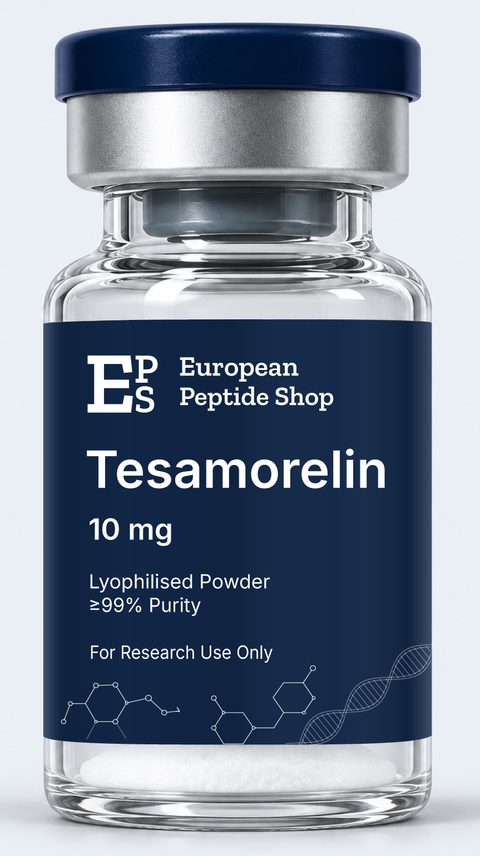
Tesamorelin research explained
What tesamorelin is
Tesamorelin is a synthetic analogue of human growth hormone-releasing hormone (GHRH), the 44-amino-acid peptide the hypothalamus releases to signal the pituitary. It carries a trans-3-hexenoyl group at the N-terminus, a modification made to stabilise the molecule. The catalogue record gives about 5,135.9 Da and CAS 218949-48-5.
It is a GHRH-receptor agonist peptide. It is not growth hormone itself, and it is a different class of molecule from the ghrelin-receptor agonists it is often listed beside.
Nomenclature and synonyms
"Tesamorelin" names the peptide. "Tesamorelin acetate" is its acetate salt, which is the form used in the licensed pharmaceutical product. Listings sold as pens, or under a brand name, describe other products, not this catalogue item.
Supplied form
Lyophilised powder in a single-compound vial, listed on the tesamorelin 10mg product page.
Development and regulatory status
A licensed pharmaceutical form of tesamorelin exists in some jurisdictions, approved for a specific indication in HIV-associated lipodystrophy. That approval attaches to a particular product, indication and patient population. It does not extend to the research material supplied here, and nothing on this page implies a UK licence or availability for human use.
The catalogue item is a laboratory reagent, supplied for non-clinical in-vitro research only.
The distinction matters because much of what is written online about tesamorelin describes the licensed product's clinical programme. Those documents answer questions about a medicine, a prescriber and a diagnosed population. A research reagent has none of those, which is why this page keeps the two apart.
In vitro and animal findings
Preclinical literature that is specific to tesamorelin is small. Most of what is published concerns the pharmaceutical product in human studies, so there is little animal or cell data to anchor claims about a research reagent.
Human data
Randomised, placebo-controlled trials of the pharmaceutical product exist in HIV-associated lipodystrophy. One example is a 50-participant trial reported by Braun and colleagues in 2017. Those results belong to that product, that population and that clinical setting. They cannot be carried over to a different material, population or purpose.
What tesamorelin is often confused with
| Compound | Class | Target |
|---|---|---|
| Tesamorelin | 44-amino-acid GHRH analogue | GHRH receptor |
| CJC-1295 | Modified GHRH-derived analogue | GHRH receptor |
| Ipamorelin | Short pentapeptide | Ghrelin receptor |
- Tesamorelin and ipamorelin are frequently paired in search terms. They are structurally unrelated and act at different receptors; one is not a stronger form of the other.
- Growth hormone (somatropin). Tesamorelin is a releasing-hormone analogue, not the hormone it signals for.
- Sermorelin. An earlier, shorter GHRH analogue covering residues 1-29. It is related in class but differs in length and modification.
- Other GHRH analogues. Ipamorelin, CJC-1295 and Sermorelin are compared separately.
Analytical documentation
The guides to reading a peptide COA and understanding HPLC purity explain what those figures can and cannot show. The growth hormone category and the tesamorelin buying guide cover the catalogue side.
EPS documentation
Use the research catalogue to check the exact name, labelled amount and format. The COA library publishes the original Janoshik reports selected for EPS, retaining the original report client name and any missing batch fields. Literature findings and another supplier's analytical results are not evidence about an EPS batch.