How retatrutide targets three receptors
The proposed mechanism in outline
Retatrutide (development code LY3437943) is a single peptide designed to activate three receptors at once: the receptor for glucose-dependent insulinotropic polypeptide (GIPR), the glucagon-like peptide-1 receptor (GLP-1R) and the glucagon receptor (GCGR). That is why it is called a triple agonist. Each receptor normally responds to a different natural hormone, and the design idea is one molecule that engages all three.
Its development status and what the published trials report are covered on the retatrutide identity page. This page is only about how the molecule is proposed to work.
Molecular targets
All three targets belong to the same receptor family. They are class B G protein-coupled receptors on the cell surface, and each signals mainly by raising intracellular cyclic AMP when activated.
| Receptor | Natural ligand | Where it is mainly found |
|---|---|---|
| GLP-1R | GLP-1 | Pancreatic islet cells and parts of the brain |
| GIPR | GIP | Pancreatic islet cells, adipose tissue and parts of the brain |
| GCGR | Glucagon | Liver cells (hepatocytes) |
Model systems the targets were identified in
The activity of the molecule at each receptor was characterised in cell-based assays, where cells engineered to carry one receptor are exposed to the peptide and the cyclic AMP response is measured. A 2022 paper by Coskun and colleagues in Cell Metabolism, written by the developer, reported that in vitro retatrutide showed balanced activity at GCGR and GLP-1R and greater activity at GIPR. Because the authors are the developer, this is developer-reported data and should be read as such.
Demonstrated versus inferred
The evidence tier matters more here than the headline. A claim about a receptor in a dish is a different kind of claim from a claim about a person.
| Statement | Evidence tier | Status |
|---|---|---|
| The peptide activates GIPR, GLP-1R and GCGR | In vitro | Demonstrated in cell assays, developer-reported |
| Activity is balanced at GCGR and GLP-1R, higher at GIPR | In vitro | Demonstrated in cell assays, developer-reported |
| Adding glucagon-receptor activity raises energy expenditure in obese mice | Animal | Reported in mice only |
| Each receptor's separate contribution in humans | Human | Inferred, not isolated |
The last row is a limit of the design rather than a gap in effort. When one molecule acts on three receptors together, the contribution of each cannot be separated by studying that molecule alone. Statements about what each receptor adds in people are inferences from related single and dual agonists.
How this differs from adjacent compounds
The contrast is in receptor coverage, not in a product comparison.
| Compound | Receptors engaged |
|---|---|
| Semaglutide | GLP-1R |
| Tirzepatide | GIPR and GLP-1R |
| Retatrutide | GIPR, GLP-1R and GCGR |
Semaglutide and tirzepatide are the names of licensed medicines. This page compares receptor pharmacology only and says nothing about their clinical use. The three compounds are set side by side in the retatrutide, tirzepatide and semaglutide research comparison.
The glucagon receptor is the distinguishing element. Glucagon is traditionally associated with raising blood glucose, so how the glucagon component is balanced against the other two receptors is a design question, and the mouse data above is the main published basis for including it.
Open questions
- Human contribution of each receptor. Not separable from a single triple agonist, as above.
- Independent data. Most of the mechanistic characterisation is reported by the developer. Independent replication in the open literature is thinner.
- The research reagent versus the clinical product. Published mechanism describes the developer's molecule. Whether a given research batch matches it is a question of identity and purity, which is what a batch certificate in the COA publication status addresses. A certificate reports what was measured in that batch and nothing about biological activity.
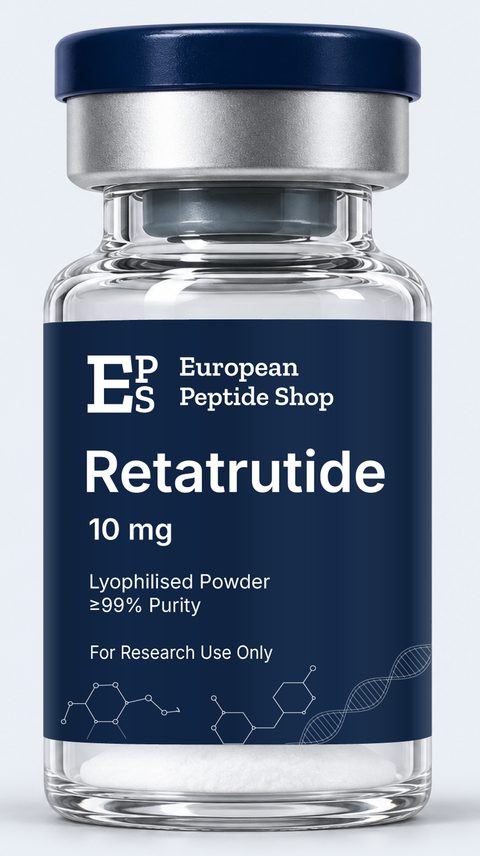
The catalogue items are the retatrutide 10mg, 20mg and 30mg vials, and the retatrutide vial guide explains how to check a vial against its paperwork.
EPS documentation
Use the research catalogue to check the exact name, labelled amount and format. The COA library publishes the original Janoshik reports selected for EPS, retaining the original report client name and any missing batch fields. Literature findings and another supplier's analytical results are not evidence about an EPS batch.
References
- Jastreboff AM, Kaplan LM, Frías JP, et al. Triple-hormone-receptor agonist retatrutide for obesity: a phase 2 trial. N Engl J Med. 2023;389(6):514-526.
- Bellido V, le Roux CW, Ekinci EI, et al. Retatrutide in adults with obesity and type 2 diabetes (TRIUMPH-2): a double-blind, parallel-group, randomised, placebo-controlled, phase 3 trial. Lancet. 2026;408(10563):1455-1472.