What is retatrutide?
What retatrutide is
Retatrutide (development code LY3437943) is an investigational peptide that activates three receptors: the GIP, GLP-1 and glucagon receptors. Eli Lilly developed it. It is not a licensed medicine in the UK or, to the knowledge, anywhere else.
The rest of this page covers names, status and what the published evidence does and does not support. How the molecule is proposed to act on its three receptors is covered separately on the retatrutide mechanism page.
Names and spellings
"Retatrutide" is the name of the molecule. "Reta" is common shorthand for the same thing. Neither is the brand name of a licensed product, and no licensed product contains it.
Supplied form
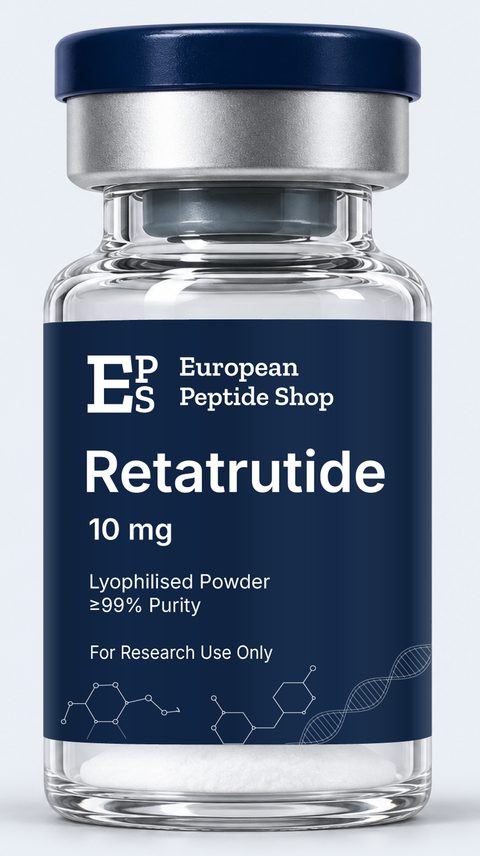
Lyophilised powder in single-compound vials of 10mg, 20mg and 30mg, each certified as its own batch. The retatrutide buying guide lists the formats. The catalogue item is a laboratory reagent. No pen or ready-made injection is supplied, and listings that describe one are describing a different product.
Development and regulatory status
- Investigational. Lilly describes retatrutide as an investigational medicine. A development announcement should not be read as marketing authorisation.
- Late-stage trials. Lilly reported results from the phase 3 TRIUMPH-2 and TRIUMPH-3 trials in July 2026 and has said it plans its first regulatory submission, to the US FDA, in the first quarter of 2027. We have found no announced UK submission.
- No UK licence. Nothing on this page implies that retatrutide is licensed, prescribable or available for human use in the UK.
Human trials of the sponsor's product
Two peer-reviewed trials anchor the record, both sponsored by Eli Lilly:
- A phase 2 randomised, placebo-controlled trial in 338 adults with obesity, run for 48 weeks and published in the New England Journal of Medicine in 2023.
- The phase 3 TRIUMPH-2 trial in 1,152 adults with obesity and type 2 diabetes, run for 80 weeks and published in The Lancet in 2026.
Gastrointestinal events were the most commonly reported adverse events in both. TRIUMPH-2 also reported dysaesthesia and hypotension more often than placebo, and more discontinuations because of adverse events in some retatrutide groups.
These are findings about a clinical formulation given under a trial protocol to defined patient populations with medical supervision. They do not transfer to a research reagent, another supplier's material, or any use outside a trial. The retatrutide side effects page sets out the adverse events those trials reported.
Laboratory and animal findings
This page cites no preclinical studies. The published record is mostly the sponsor's clinical reporting, and no in-vitro or animal finding is presented here as a human outcome.
What retatrutide is often confused with
| Compound | Receptors engaged | Status |
|---|---|---|
| Retatrutide | GIP, GLP-1, glucagon | Investigational |
| Tirzepatide | GIP, GLP-1 | Licensed medicine, including in the UK |
| Semaglutide | GLP-1 | Licensed medicine, including in the UK |
The three are separate molecules studied in separate trials, and results for one say nothing about another. The retatrutide, tirzepatide and semaglutide comparison sets out the receptor differences, and GLP-1 peptides versus classic research peptides explains why this class rests on a different evidence base.
Analytical documentation
Each vial is its own batch with its own certificate:
| Format | Batch | HPLC purity |
|---|---|---|
| 10mg | 100234 | 99.682% |
| 20mg | 100235 | 99.516% |
| 30mg | 100236 | 99.831% |
Product pages: 10mg, 20mg and 30mg. Report publication status is shown in the COA publication status. A certificate reports the identity and measured purity of the batch tested. It says nothing about biological effect and does not extend to other batches. The guides to reading a peptide COA and understanding HPLC purity explain the limits, and current prices are listed separately.
EPS documentation
Use the research catalogue to check the exact name, labelled amount and format. The COA library publishes the original Janoshik reports selected for EPS, retaining the original report client name and any missing batch fields. Literature findings and another supplier's analytical results are not evidence about an EPS batch.
References
- Jastreboff AM, Kaplan LM, Frías JP, et al. Triple-hormone-receptor agonist retatrutide for obesity: a phase 2 trial. N Engl J Med. 2023;389(6):514-526.
- Bellido V, le Roux CW, Ekinci EI, et al. Retatrutide in adults with obesity and type 2 diabetes (TRIUMPH-2): a double-blind, parallel-group, randomised, placebo-controlled, phase 3 trial. Lancet. 2026;408(10563):1455-1472.