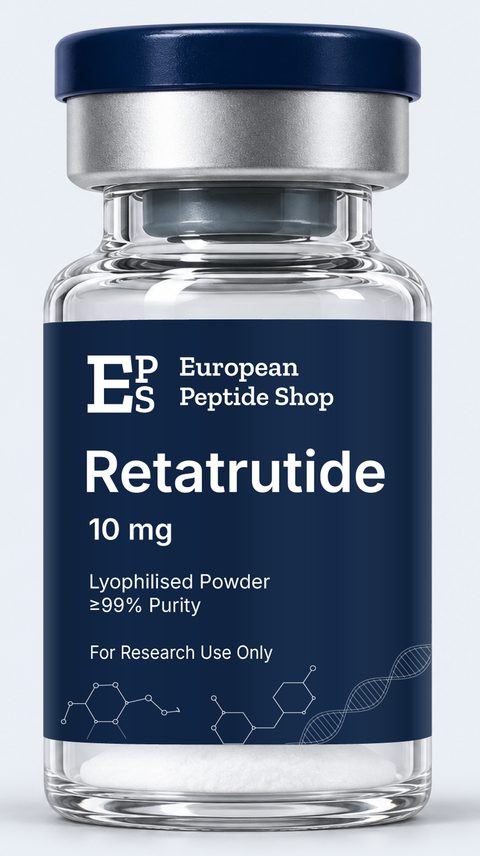
Retatrutide research evidence
October 2026 update: retatrutide versus Ozempic
On 28 October 2026, Lilly announced topline findings from TRANSCEND-T2D-2, a phase 3 comparison with injectable Ozempic in adults with type 2 diabetes. The developer reports that the trial met its primary and key secondary endpoints. Detailed results were still planned for a medical meeting and peer-reviewed publication in that announcement. Read Lilly's dated release.
The ClinicalTrials.gov record, NCT06260722, last updated on 28 September 2026 when checked, describes a randomised, open-label comparison. Its primary outcome is change in HbA1c at week 80. Open-label means the study was not masked; it should not be described as a double-blind trial.
| Evidence question | What the available sources say |
|---|---|
| Which population? | Adults with type 2 diabetes inadequately controlled with metformin, with or without an SGLT2 inhibitor |
| Which comparison? | Retatrutide versus injectable semaglutide marketed as Ozempic |
| Which primary outcome? | Change in HbA1c at week 80 |
| What publication stage? | Sponsor topline announcement; full publication was forthcoming |
| Why do enrolment figures differ? | The September registry lists an estimate of 1,250; the later sponsor announcement reports 1,298 |
Lilly labels its reported outcomes as an efficacy estimand: an estimate under specified assumptions about remaining on study intervention without additional glucose-lowering medication. That is a different question from the outcome of every participant regardless of subsequent treatment changes. The release also reports adverse events and discontinuations, which must be considered alongside efficacy.
This comparison does not establish a result against every semaglutide product, every regimen or every patient population. It adds sponsor-reported comparator evidence to the record below; it does not authorise retatrutide or establish the properties of a retail research vial.
Checked 5 November 2026. Trial regimens are not laboratory preparation instructions or recommendations for human use.
The shape of the literature
Retatrutide (development code LY3437943) is an investigational peptide that activates the GIP, GLP-1 and glucagon receptors. Eli Lilly developed it. The cited discovery paper dates from 2022; the subsequent evidence includes clinical trials with different populations and endpoints.
Three features define it:
- It is a sponsor-led literature. The founding preclinical paper and the first-in-human papers have Eli Lilly authors, and every trial listed below was funded by Lilly. Academic investigators are co-authors on the larger trials, but the programme belongs to the developer.
- Its preclinical base is narrow. The receptor and animal characterisation we cite comes from one paper by the developer. We have not relied on independent replication of it.
- It describes one clinical formulation. Each human result concerns the sponsor's product, made and controlled for a trial and given under a protocol.
What the molecule is and where its development stands is on the retatrutide identity page. How it is proposed to act is on the retatrutide mechanism page. This page covers what kind of evidence exists, tier by tier.
In vitro findings
The founding paper (Coskun and colleagues, Cell Metabolism, 2022) reports cell-based assays in which cells carrying a single receptor are exposed to the peptide and the response is measured. In that system retatrutide showed balanced activity at the glucagon and GLP-1 receptors and greater activity at the GIP receptor. This is developer-reported data from an assay, and it establishes behaviour in that assay only.
Animal findings
The same paper reports work in obese mice, in which administration was associated with changes in body weight and glycaemic control. The authors attribute part of the effect to glucagon-receptor-mediated energy expenditure acting alongside the GIP and GLP-1 receptor activity.
That is a result in one rodent model from one group. It does not show the same mechanism operates in people, and no other species is covered by the sources cited here.
Human data
The human studies cited on this page are listed below. All were funded by Eli Lilly.
| Study | Population | Duration | Design note |
|---|---|---|---|
| Phase 1b, Lancet 2022 | 72 adults with type 2 diabetes | 12 weeks | Primary outcome was safety and tolerability |
| Phase 2, NEJM 2023 | 338 adults with obesity | 48 weeks | Randomised, placebo-controlled |
| Phase 2, Lancet 2023 | 281 adults with type 2 diabetes | 36 weeks | Placebo and active comparator; primary endpoint at 24 weeks |
| TRIUMPH-1, phase 3, NEJM 2026 | 2,339 adults with obesity, without diabetes | 80 weeks | Placebo-controlled; sub-studies in knee osteoarthritis and sleep apnoea |
| TRIUMPH-2, phase 3, Lancet 2026 | 1,152 adults with obesity and type 2 diabetes | 80 weeks | Placebo-controlled |
Primary endpoints differ by study: safety and tolerability in the phase 1b study, change in HbA1c in the phase 2 diabetes trial, and change in body weight in TRIUMPH-1, whose sub-studies added pain and sleep-apnoea outcomes. Each paper reports its results against its own prespecified endpoints. We do not reproduce efficacy figures here: they describe a clinical product given under supervision to selected patients, and quoting them beside a research material would read as a claim about that material. The adverse events these trials reported are set out separately on the retatrutide side effects page.
What cannot be concluded
- That trial results apply to a research vial. The trial product was manufactured and controlled to clinical standards. A research reagent has no such record, and nothing published describes what a research batch contains beyond its own certificate.
- That a phase 3 report is a licence. We have found no marketing authorisation from the MHRA, the FDA or any other regulator. The October 2026 sponsor announcement still describes retatrutide as investigational. A sponsor's development timetable is not a regulatory decision.
- That the record is long. The longest published trials ran 80 weeks. There are no multi-year data.
- That each receptor's contribution is known in people. One molecule acting on three receptors cannot be taken apart by studying that molecule alone, so statements about what each receptor adds are inferences from related compounds.
- That a retail description is evidence. Listings that quote trial outcomes beside a research product are borrowing a result that belongs to a different product.
What would need to be studied
- Independent replication of the receptor pharmacology, outside the developer's laboratories.
- Safety data longer than 80 weeks.
- Comparator work that separates the three receptor contributions.
- Analytical characterisation of non-sponsor material, including identity, sterility and endotoxin. None of the trials above addresses it.
Analytical documentation
Each catalogue vial is its own batch with its own certificate:
| Format | Batch | HPLC purity |
|---|---|---|
| 10mg | 100234 | 99.682% |
| 20mg | 100235 | 99.516% |
| 30mg | 100236 | 99.831% |
What a batch COA for this material reports
The identity and measured purity of the particular batch tested. Report publication status is shown in the COA publication status, and the product pages are 10mg, 20mg and 30mg.
What a COA cannot establish
Biological activity, sterility, endotoxin levels or suitability for any use in people, and nothing about any other batch. The guides to reading a peptide COA and understanding HPLC purity explain the limits. The retatrutide buying guide covers the catalogue side, and the three-way picture with its licensed neighbours is in the retatrutide, tirzepatide and semaglutide comparison.
EPS documentation
Use the research catalogue to check the exact name, labelled amount and format. The COA library publishes the original Janoshik reports selected for EPS, retaining the original report client name and any missing batch fields. Literature findings and another supplier's analytical results are not evidence about an EPS batch.
References
- Read Lilly's dated release
- ClinicalTrials.gov record, NCT06260722
- Coskun T, Urva S, Roell WC, et al. LY3437943, a novel triple glucagon, GIP, and GLP-1 receptor agonist for glycemic control and [...]: from discovery to clinical proof of concept. Cell Metab. 2022;34(9):1234-1247.
- Urva S, Coskun T, Loh MT, et al. LY3437943, a novel triple GIP, GLP-1, and glucagon receptor agonist in people with type 2 diabetes: a phase 1b, multicentre, double-blind, placebo-controlled, randomised, multiple-ascending dose trial. Lancet. 2022;400(10366):1869-1881.
- Jastreboff AM, Kaplan LM, Frías JP, et al. Triple-hormone-receptor agonist retatrutide for obesity: a phase 2 trial. N Engl J Med. 2023;389(6):514-526.
- Rosenstock J, Frias J, Jastreboff AM, et al. Retatrutide, a GIP, GLP-1 and glucagon receptor agonist, for people with type 2 diabetes: a randomised, double-blind, placebo and active-controlled, parallel-group, phase 2 trial conducted in the USA. Lancet. 2023;402(10401):529-544.
- Jastreboff AM, Kaplan LM, Davies MJ, et al. Retatrutide, a triple hormone receptor agonist, for treatment of obesity (TRIUMPH-1). N Engl J Med. 2026.
- Bellido V, le Roux CW, Ekinci EI, et al. Retatrutide in adults with obesity and type 2 diabetes (TRIUMPH-2): a double-blind, parallel-group, randomised, placebo-controlled, phase 3 trial. Lancet. 2026;408(10563):1455-1472.